Episode Transcript
[00:00:01] Speaker A: If you're looking for the skills and tools to succeed in real estate investing, you've come to the right place.
This show is about breaking through barriers, breaking through limiting beliefs, and breaking through to the life that you want to live through the power of real estate investing. You're listening to the Breakthrough Real Estate Investing Podcast. And now here are your hosts, Rob Brake and Quinton d'. Souza.
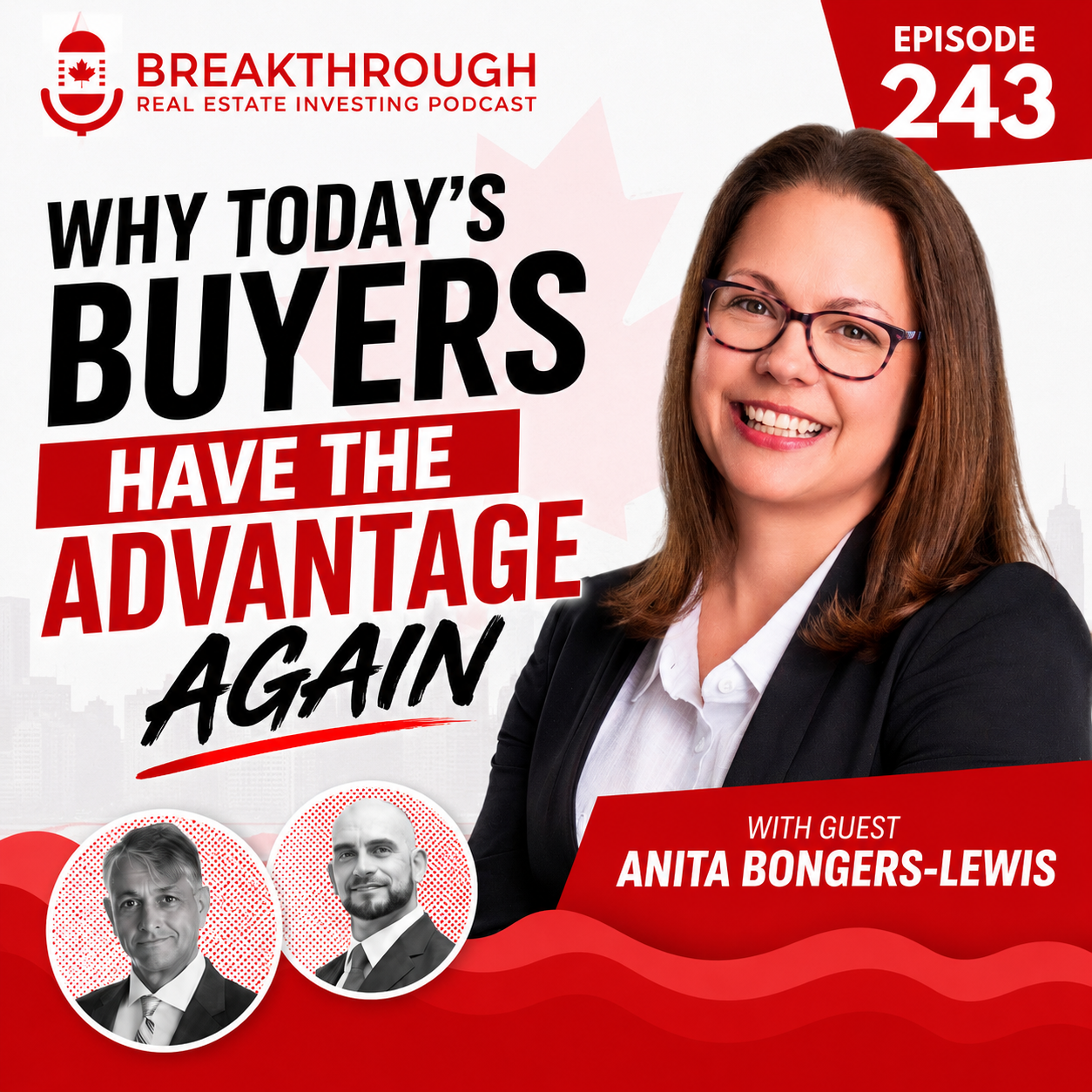
[00:00:29] Speaker B: Welcome back, everybody. Thanks for joining us again. We have another amazing guest with us today. Anita Bongers Lewis is with us as well as Quinton d', Souza, who's always here. How are you doing?
[00:00:42] Speaker C: Oh, I'm doing well, Rob. How about yourself? How's everything going in Costa Rica?
[00:00:46] Speaker B: Very good, man, very good. I can't complain. Just got back from the gym and that's going really well.
[00:00:52] Speaker C: So no complaints getting more people coming to the gym?
[00:00:57] Speaker B: Yeah, yeah, yeah. It's been doing good. It's been spreading the word. We've got some plans to expand, possibly maybe.
[00:01:05] Speaker C: That's awesome. Good stuff.
The number of members growing.
[00:01:09] Speaker B: Yeah, yeah.
[00:01:10] Speaker C: Okay, good.
[00:01:11] Speaker B: Yeah, it's doing good.
I'm happy with what, I'm happy with how it's going, so.
[00:01:16] Speaker C: Okay, awesome. Yeah, everything's going well with me.
I'm just planning my next trip as always. Heading to Italy to do the dolomites in about 10 days.
[00:01:30] Speaker B: To do the what?
[00:01:31] Speaker C: The Dolomites. It's, it's called the Altavia one. It's a hut to hut hike with my, my youngest son. So we're going, we're hiking through the Italian, the mountains just outside of Venice and about 10 days of hiking should be good.
[00:01:48] Speaker B: Oh, it's not a race.
[00:01:50] Speaker C: No, not a race. Not a race.
[00:01:51] Speaker B: Okay.
[00:01:55] Speaker C: Yes. It should be fun.
[00:01:57] Speaker B: Wow.
[00:02:00] Speaker C: You know what?
[00:02:00] Speaker B: Got a lot of adventures under your belt.
[00:02:02] Speaker C: I'm trying. I really am.
[00:02:06] Speaker B: Excellent. Anything else you want to share? Some little tidbits of knowledge that you got in your head?
[00:02:11] Speaker C: I don't have that many right now. I'm just trying to get through my. Another refinance. We just got in it, a refinance with. On a 20 unit building where we severed the lot and had some issues with some pin numbers and MLI select and you know, a bunch of different complications. But you know, we, we just got it funded so I'm pretty happy about that.
[00:02:35] Speaker B: Oh, wow.
[00:02:35] Speaker C: That. Congratulations took a while, but I think it was a big number. I think it was like a 10 million dollar mortgage too, so. It was a big, big mortgage. I can't, I can't remember off the top of my Head how much it was, but it was a big number, so getting that done was good. And we have upcoming social with Durham rei, so that's going to be fun. I rented an ice cream truck, so we'll.
[00:03:00] Speaker B: We'll have you just go into a parking lot with an ice cream truck or what's the plan?
[00:03:04] Speaker C: Someone's backyard. We're going to Dan Hogenberg's backyard.
[00:03:08] Speaker B: Okay.
[00:03:08] Speaker C: And he's got a lot of land. He's. He's also a landscaping.
You know, it's got that landscaping background. So it'll be fun. And Anita's gonna be there, and we'll have a lot of members come out and we'll have a good time.
[00:03:22] Speaker B: Oh, man, that does sound like fun.
[00:03:23] Speaker C: Yeah, it will be.
[00:03:25] Speaker B: Okay, well, that sounds good. Anyone listening should go over to. Not Duramaria. Well, do go over to duramaria.
Is it duramaria.com and. Yeah, I think both.
[00:03:36] Speaker C: Yeah, both work.
[00:03:37] Speaker B: Yeah, we'll go over to learn about more of that, but also go over to BreakthroughReipodcast CA and listen to all the past podcasts there and then rate and review us on itunes, please. It really helps.
And that's it.
Let's get to our guest.
[00:03:55] Speaker C: All right, so I'm excited to talk to Anita here.
And we know each other. We all three of us know each other for a very long time.
So maybe you could just tell us a little bit about yourself.
[00:04:11] Speaker B: Sure.
[00:04:12] Speaker D: I've probably known both of you for about the same amount of time, probably roughly 2013, I'd say, because that's when I started coming to Durham rei. So I currently am a Realtor. I own the Doris Wealth Real Estate Group. I'm the team lead and owner and focusing on investors and people building wealth through equity. But prior to that, a real estate investor before I became a Realtor, a chiropractor before that. Focusing in the Durham region, mainly in the areas in beyond there. And yeah, Durham REI was one of my first introductions to. To investing in real estate. And I think. I think you guys both know or certainly Quentin knows. I. I only miss it if I'm out of the country, so.
[00:04:53] Speaker C: Yeah, that's awesome.
[00:04:53] Speaker B: Yeah, me too.
[00:04:56] Speaker D: I like that, Rob.
[00:04:57] Speaker B: I. I haven't been there in a while, though, but I do miss it. I really do. That's one of the big things that I miss, for sure.
You know, they are a lot of fun. So if people are thinking about even just like for someone who doesn't know anything to come out and meet people that are doing exactly what you might want to do, it's, you know, no amount of money. I don't even know what you charge, but whatever it is, is well, well worth it.
[00:05:23] Speaker C: Yeah, it is a lot of fun. And you know what? I actually had a couple, one of two of my son's friends came over and we ended up playing the real estate cash flow game just so that. Because they, they wanted to learn about real estate. So I started off with the, the game because it's a lot of fun. And then I was like, ah, you should just come up to a meeting, which makes it easier.
You'll meet a lot of people.
But so I mean, Anita, you, you were a chiropractor before. So like that means you have, don't you have a doctor in front of your name or something like that?
[00:05:58] Speaker D: Yeah, I have a clinical doctorate. Yeah. So I, yeah, I did nine years of post secondary and then another year to get my acupuncture license and then ended up moving being a realtor instead of that. I did it for 10 years. It was lovely. And it, it's what if. It's what got me the income to really start aggressively investing in real estate. So it was a really great start. I really loved what I did, but also really welcomed the transition, which just kind of happened naturally in life. Right. It just presents certain paths in front of you and you might have thought you were going one direction, but sometimes a different path opens up and it's exactly where, where you should be or where you want to be.
[00:06:34] Speaker B: Yeah, it wasn't just, it wasn't just like you woke up one morning and decided, I think I want to be a realtor. There's definitely a progression there where you, you, you started investing at a certain point probably, I don't know, a few years into being a chiropractor. Is that right?
[00:06:49] Speaker D: Yeah. So initially we actually had a few condos that we purchased pre con, and then my husband had a condo that he had from before we got married. And that was sort of how we loosely got started. Almost by accident, just some opportunities came up, but it became intention.
That all happened right after I graduated. And then it became much more intentional in and around 2013 where we chose a specific strategy. We actually sold all the condos we owned to buy properties in the Durham region and moved from the west end of Toronto to the Durham Region all at the same time. Just followed what we thought was the best path. But yeah, it was.
I got my license because I'm. Well, if you know my history, I'm a little Bit of a nerd. I like to learn things. So I got my license just because I wanted to learn more about real estate. No more. We were doing enough deals. We thought maybe we'd just do our own deals. That was always the intention. It wasn't the intention to get my license to become a realtor, but the realtor I had previously worked with was looking to slowly retire and it was a neat opportunity that presented itself and that's, that's what led me to where we were at. And we had so much success with it. We wanted to help other people have similar success.
[00:07:53] Speaker B: So start off with some of the early investments that you made. What were they and why did you choose them and all that kind of stuff.
[00:08:02] Speaker D: Yeah, so our intention was really the burst strategy from the start. Once we got out of the condos and in towards investing in the Durham region, we really wanted to get towards the brrrr strategy. First one that we bought was a semi detached house that we were going to convert to two units.
Knowing what I know now versus knowing what I knew then, I probably would have approached it very differently. But we ran into a challenge with, with the very first one where we didn't have the frontage we thought we did. We couldn't meet the parking requirement to convert it to two units. And as first time investors with this strategy, it was pretty intimidating and we pivoted. We changed it to a student rental because of the location, which actually worked out really well. Cut our renovation budget down drastically. We held that property for quite a few years and it cash flowed very, very well for us. That was the first one. So we really thought we had messed up quite badly actually when we couldn't do what we wanted to do. But it worked out to be a bit of a cash king for us from the start. I mean we're talking purchase price of $250,000 to start off with. So that that can work out pretty well when you convert it to a six bedroom student rental.
So that was one of the first ones. Looking at what I know now, I mean I could have applied for a minor variance and solved that so easily. But as a newbie that sounded intimidating and we just pivoted and then we actually bought many properties in our first year that we were investing in the Durham region. We had sold the condos that we owned and we started buying properties in the Durham region instead. Focusing on a few that were turnkey two units and then others that we would convert to two units and just refinance, get some funds out and Move on to the next one. We also had a tendency to house hack. We didn't know what that was. That's not what it was called back when we started investing. But we've lived in almost every one of our, our duplexes, our two unit properties, just for us, it was a way to just cut expenses. Instead of having a primary residence that we paid a mortgage at, and then this other property that we were renovating or getting ready, we would move into the next property and renovate it while we were there, meaning we got to save on one mortgage, which was really nice. Also, we could get tenants placed before we moved out, and we would plan our new tenants to come in just as we were moving out to go to our next property. We did that all a lot in our first year. We were aggressive in our first year and we had our first child in that first year too, which was. Was a lot of chaos in there too. But we initially we moved so quickly that I do remember one of the homes we lived in. I was due in a month for our first child to have our first child. And this is the house, Quinton, you were in. We did a little interview with you in this house.
And I remember the day my mover came to move me. And at one point we moved 10 times in six years.
So when my mover knew me well that day, I would always spam cash at the end and you know, nice tip at the end. And I remember telling Mike, our mover, okay, that's great, you moved us in today. I have our next move date for our next property. So can I book you for our next move? So we did a lot of the house hacking to kind of just make it a little bit of a better economy for us and to save a bit of money. And, you know, we were young, we didn't have kids yet. We could really handle the inconvenience of that, if that, if that's what you want to call it.
[00:11:02] Speaker B: I guess it's all roughly in the same area.
[00:11:05] Speaker D: Yep.
[00:11:06] Speaker B: Yeah. So that, that makes it relatively easy.
[00:11:11] Speaker D: Yeah. We didn't have kids who were in certain schools where we had to worry about, you know, they're going to transfer schools if we move or things like that. Right. Like we're at a different stage in life now where I would not subject my kids to changing schools because we want to move all the time.
I mean, most people would still keep them in the same school anyways, even with all the moving. But at this point, I have a 10 and a 5 year old I, I don. Want to keep moving them. That's not nice for them.
But yeah, it was a really great option to just kind of leverage ourselves and move through the properties.
We didn't take advantage of putting less than 20% down with this because if you do that repeatedly and in short sequence, you're going to get flagged pretty quick. We did it once with one of our properties, but that was, that was it.
But otherwise it was still 20% down as if it was an investment property. But we just moved through them pretty quickly and we grew really aggressively in our first year.
[00:12:01] Speaker B: Well, it does make sense too, because you've got an apartment that's pretty much most of the time anyways ready to move into. Which, you know, from my experience, and when I did it, I usually kept the upper unit vacant because of all the noise and the dust and the controversy that it can create if you do put somebody in there while you're renovating in the basement.
So, you know, it's you guys doing it and subjecting yourself to it. It's a lot easier to handle.
[00:12:30] Speaker D: Yeah, exactly. Yeah, yeah.
[00:12:33] Speaker C: And I, I think, you know, the, the way that you would have done it, you would have actually pulled out capital.
So although you put 20 down on the, on the refinance, were you able to pull up more than, than, or were you able to reutilize the capital into your next project? How did that.
[00:12:52] Speaker D: It was usually a complete burr. It was back then we were pretty much getting a complete br where we'd have down payment for the next property as well as our renovation funds out or very close to a complete brrrr. Back then we were still working, you know, in our nine to five jobs as well, both of us. And we did make a good income as well, which helped certainly. But we were able to get a lot of capital out of each of the properties and that helped dictate us moving to the next property too.
[00:13:17] Speaker B: Right. So that's very, very powerful because if you can do that over. What did you say, 10 moves?
[00:13:24] Speaker D: 10 moves over six years. That, that included us moving from the West End to the East End. But yeah, and truly we didn't intend to end up in Durham. We wanted, we intentionally invested in Durham, but we knew that I would be on my maternity leave right. Shortly after we bought that first property. So we thought at the time, let's, let's move to Durham region because I'll be on maternity leave, so it won't affect my work. And my husband Chris, who you guys both know, commuted downt down anyway. So whether we were going from Etobicoke, where we lived before, or Oshawa, it didn't make much of a difference time wise for him. So we thought we would live in that community and get to know it a little bit better because we really thought we would invest aggressively and we just never, never left. We have stayed in the Durham region ever since and the house hacking was part of it. But also we love living in Durham.
[00:14:13] Speaker B: Well, I don't want to breeze over this because it like, like for the, for those listening that don't really understand what you're saying, what you're saying is that when you would move into a place and, and renovate it, once you put the new mortgage on the, on the renovated property, essentially you would get back all of the money you put in to the place and then you would move like all of it.
[00:14:38] Speaker D: Yep.
[00:14:38] Speaker B: Right. So.
[00:14:39] Speaker D: Yep.
[00:14:39] Speaker B: Then you'd move on to the next one and do it again. And back then you're saying that you did that several times where there was.
[00:14:47] Speaker D: Yeah, so.
[00:14:47] Speaker B: So we might have zero percent capital left into these properties once you did, once you made the move.
[00:14:54] Speaker D: Yeah, for the most part we'd come close to. Close to zero. Most part. And we were dealing with numbers back then that were maybe we're purchasing in around 350 and then refinancing out at say 500.
Renovations were a little cheaper back there back then as well. They have obviously escalated, but different price points as well. But yeah, that, that's essentially what it was. Maybe we have to throw in another, you know, 10,000, 20,000, worst case scenario, which we were in a position to do. We did offload multiple condos before we started this. So we did have a healthy pocket to get us into the first few. And then the refinances allowed us just to continue that.
[00:15:27] Speaker C: Yeah, and I mean, what worked then doesn't always work now. And you know, some of those strategies that were working have to be modified. So.
[00:15:37] Speaker B: Right.
[00:15:38] Speaker C: What are your, what are your buyers and sellers and investor. Buyer and sellers doing now?
[00:15:44] Speaker D: Yeah, so it depends if I've got somebody who's more of a newer investor or if I have somebody who's more of a seasoned investor. So a lot of clients have transitioned to different strategies. Right now we have a lot of flippers who are very active in this market, which has been working really well. And I can explain, you know, separately why that works really well right now for my seasoned investors, they are not as active unless they're doing something more into the Commercial side of things. Because of the financing end of things, it has become really challenging for the, the people who have, say, 10 properties to get good financing, get lenders to approve them because of rental offsets and how they're qualifying the income.
A lot of my clients are new investors, people who have worked really hard to pay off the mortgage on their primary and are mortgage free and thinking, well, if I was to put this money into an rrsp, why would I, wouldn't I put it into a property instead? I haven't got my own mortgage to pay, so I've got, you know, I don't have that cost every month. So let's, let's invest into something for my kids, for my future, create my own pension. We've seen a lot more investors, new, new investors coming to the market. It was a little quiet for that for a lot of years as well. And then a number of my clients have, like I said, moved into commercial or infill development or change of use. So because of rule changes and bylaw changes and legislative changes, we can now do three units as of right. In some areas, four units as of right. So they're looking at converting instead of the traditional duplex conversion we were doing, you know, all, all of us, it's getting into three and four units or into infill development as well. So it's just a different level. For the seasoned investors. It is much like when I bought my first property and was intimidated to look for a minor variance. Right. The more you learn, the less intimidating it is. And it is just numbers and deal analysis. Again, it's just on a bit of a different level.
[00:17:35] Speaker B: Well, it is interesting because, like, when I first started doing wholesaling, right, there was a lot more because everyone at Durham REI was looking for properties that they could put a second suite into the basement. If you brought that to the investor group, it was gold. But back then there was certain areas, right. Like the zoning was different.
And so then one day they just said, how about this? We're just going to open up the. All of Oshawa to allowing secondary suites. And then that was a gold mine. And now they've changed the.
Now they've changed a lot of the regulations to allow 3 and 4 units and infill developments. So that does sound like for somebody new, you know, that wants to get into it, the opportunity sounds pretty good.
[00:18:25] Speaker D: Yeah. Yep. There's definitely opportunities there. And it's, it's funny even for my seasoned investors, you know, I can think of clients who, when we were in the heyday back in like February 2022, that was the height of the market. That was the month we saw all the highest prices. Things were bananas. And then we saw a real quick correction start happening right after that. And we had seasoned investors who wanted to offer $1 million on what we call grandma's bungalow. And when I say that, I mean the bungalow that has not been updated since maybe the 50s, 60s. Right. And those were, were good options because when you put in the sweat equity, that's usually when you increase the value the most, which is great.
But now we see those same properties selling for 600 and those season investors are, are sitting by the sidelines. To be honest with you. I, I don't know when things will shift so that they're ready to take action again because I've run the numbers. I mean if we look at the prices, we're back to about 2020 prices, the end of 2020 prices right now in Durham region.
And the interesting thing is if you were buying then but you're not buying now, I question why. Because our prices for, for the same home is about equal, but our rents are easily for that occupied two unit, easily 800 bucks a month more. Even though we've seen rent corrections. I actually went back and looked at three lease placements I did in 2020 to see what was I getting for an upper three bedroom versus a lower two bedroom. And back then and I had to write the numbers down so I don't forget I was getting around 1700 for an upper unit 3 bed and only about 1350 for the lower unit. And now even, even though things have corrected, we're still getting like 20 217.
So like the, the disparity and the rents and, and the prices, the prices have directed back to, to that time, but our rent potential is still so much greater than it was back then.
[00:20:29] Speaker C: So, so why do you think that that's like that's changed? Because I, I like when I talk to people who have been investing for a long time, there's a lot of build built up of different levels of frustration that, that have, that I've kind of seen which is landlord tenant board issues, you know, taking six months or a year to get somebody out and then you know, the landlord 10 like the residential Tenancies act in Ontario changing every time. It seems to make it even harder and harder for landlords. Like you know, the, the recent change on January or July 1st around the ability to add in air conditioning and then you know, working that like there's Always, always something.
And although there are some improvements happening starting September 1st, changing from 14 days to 7 days for, for, but, but it still takes you how long to get an order and then on top of that eviction and then on the financing side, which is a big deal I think for experienced investors like me.
Like I, if I go to, I have the net worth at the wazoo and I have income at the wazoo, but I have no T4.
So yeah, like I can't, I can't qualify for a mortgage, but I probably have more income than, than most like a dozen families combined. It doesn't make sense, right?
[00:22:01] Speaker D: No, no. And, and I, I think the lenders and the government is, is really pushing that because they, they want to make sure they're helping the homeowner and not the investor. I doing with, with affordability. But for, for those clients. Yeah, I, I think LTB issues. I think it is, it's funny, it isn't even that our, our LTB or RTA has changed that much to make it more favorable for tenants. It's, it's been the delays, for sure.
It's been the delays that's been a big issue, which to be honest with you is largely reduced, certainly for non payment of rent. Those are the ones that have been corrected the best. And we're finding that the hearings are happening within two to three months, which is a lot faster. I know back I had to do one with a tenant back in, I want to say 2015 and we got a hearing in about 30 days, which was the norm back then. So certainly that is a deterrent and it's the fear of professional tenants. I don't think that the LTB has changed so much as tenant education amongst. Education amongst tenants and them supporting each other and the information on how to work the loopholes and how to work the system. I think, I honestly think it's, it's this information that's out there that is the bigger problem. It is, but it's affecting us as landlords. Absolutely it is. A lot of the delays have been a lot better as of late. So I understand where people are concerned about that with, with the, the, the RTA and ltb. But I still think if managed properly, there are ways education, just like the tenants are educating themselves, you need to be just as educated, you need to be more educated. Right. It's your asset. And I can say, you know, size of portfolio doesn't matter, but we own many properties and we've owned them, even the condos before that, since about 2010 is when we started and I've ever had to go to the board for one eviction. Now, I'm not saying my tenant screening is perfect. No screening is perfect. But we've had to go for one eviction. And I do think if your diligence and education is done appropriately, you can mitigate a lot of this. I think a lot of the big landlords sometimes don't worry as much about their diligence on tenant placement because they've got economy of scale. So they're pricing in some delinquencies and LTV and all that kind of thing. But it's a lot harder for the small landlord. Right. If they only have a couple of properties, one vacancy, one, you know, one tenant in arrears, that can really affect them a lot. So I think a lot of people have certainly been speaking highly of investing in other areas. So Calgary for, for example, right. Because favorable LTB in the US things like that, certainly people have been favoring a lot of that because that side of things is a lot easier, which, absolutely, if you're comfortable with having something that's not in your backyard, is a good investment. I know, you know, Quinton, lots of people who do that as well.
For myself personally, like, I think you've had this conversation with us at Durham REI before. When you invest in the U.S. it's for funds that will remain in the U.S. for you to do things within the U.S. right. It's not funds you're bringing back home and you have to worry about anything like that. That's a little bit of a different animal than if, you know, you're really focusing all your income generation in another country. I'm a little bit adverse to investing in another country where I do have concerns that governments can change and taxation can affect my investment in different ways. It can happen here in Canada and Ontario too. But I do feel a little cautious about investing another country where a foreign investor may at some point be seen as a very negative thing. But investing like you are for, for using income in another country, completely understand that, or vacation properties, things like that as well.
Calgary, again, really has been a really good market, but also because their LTB rules are so lax, you are very much subject to what, what rents are. So you may do really, really well, but those rents can change and dip very aggressively based on how the economy is doing and what people need to. So I'm not saying one's better than the other. I think it has to fit what. Get what you want. So we like. I like Investing sort of in my own backyard, so I have an asset that I can monitor a little bit. I don't do it myself, but it allows me to understand my market and to invest in something that I can see if I want to see. And I like to stick to one or two areas so that I can have the economy of scale, too, where I have, you know, my power team there to help manage that as well. But, yeah, I'd say that's the big one. LTV is probably what scared people. And it's a shiny object syndrome where they see something else somewhere else. They like the numbers, they work really nice, so they want to give that a try. I also know investors want to make sure they get it when it's at. At the low. They want to buy at the bottom.
[00:26:37] Speaker C: Yeah, yeah. Who, who, who has that crystal ball? Let me know. I'd love to find them.
[00:26:42] Speaker D: And that. And that's my pet peeve because, I mean, the. You just have to make sure the numbers work and you stress test it. Right. Like it. You have to make sure it works, not just today. Right. And you've always pressed that upon us too, Quinton, is we stress test our rates and things like that, which is great. You have to have cash flow in order to be comfortable with it, and you have to stress test that as well.
But I am of the opinion that in a market, right, you come down and you hit a bottom and then you come up again. Well, you don't know when you've hit the bottom until probably three months later is the reality. So trying to time it that you're going to hit the bottom isn't.
[00:27:13] Speaker B: I don't even know if you know in three months.
[00:27:15] Speaker D: Like, I mean, not now, not lately. Yeah. So, but, but on the end, and Rob being a realtor as well, right. It's when you're on the way down before the bottom where you actually have the most negotiating power as things are coming down. It's a buyer's market. It's where you can, like, you can barter them down, you can ask for things, you can put in all the conditions you want. You have a lot of control. But once you hit that other side of the bottom, it's becoming a seller's market.
[00:27:42] Speaker A: Right.
[00:27:42] Speaker D: You do lose some ability to negotiate because it's becoming a hotter market because there's more demand. I would always, if I have to be on either side of that bottom, I would probably want to be on sort of the side of us coming down on the crash versus us recovering. I Think as a buyer it's the best opportunities but we can't time any of it right. We, we don't know for certain are we at our bottom? Durhams remained largely flat for price for about five months, months now. We've barely changed I think between the start of the year, between January and last month we've gone from about 8:30 for average price 830 to 853. And we've wavered up and down in between there a little up, a little down, that kind of thing. But we've remained largely flat in Durham region for, for five to six months now. So we'll see. There's just too many factors out of our control these days for us to know certainly if there is a little more room for dip or if we're going to hit recovery.
[00:28:37] Speaker B: And I mean, you know, one of the things that you mentioned that I think is important to stress is just that you're, you're not like you still have requirements in order to purchase something.
So you know, if, if, if theoretically the prices dip another like little bit, it doesn't really matter. You've met your criteria that you're looking for in order to purchase the place. Yeah. You know, and, and if you're there
[00:29:02] Speaker C: for like five or ten years.
Right. Then what does that couple percent mean? Right Rob?
[00:29:09] Speaker B: Like well it just means that you, or, or it could be the opposite way. Like you might be at the bottom and then all of a sudden things start to come up and now you're like well it's still available but it costs more now. I should jump on it before it goes up even more.
Right.
So you don't like Anita said, you don't want to be on the other side of that.
Yeah.
[00:29:28] Speaker C: What I like to hear is actually because I'm not, I'm not a realtor so I, I don't get the day to day stuff. So I like to hear like gut feel how, how does like the realtors in different markets, like how is it going? Like what's happening? And because you guys are like, you, you ladies and gentlemen are like right into like what's going on. So you know what, like if I were to think, if you were to say like right now, how do you feel the market is, is doing based on you know, what you're doing with your clients and, and you know, the transactions that you're seeing because you see it every day, right?
[00:30:10] Speaker D: Oh absolutely. And there's a huge dichotomy right now. There are properties that will sell quick in a Bidding war. And there's properties that will get no showings or will sit on the market.
And it's largely, it largely comes down to affordability at the end of the day. So I will say the investor demand has dried up a lot, except for certain properties.
So generally when we've got a property that's listed, we're not really having investors come as one of our buyers maybe once in a while, but we're not seeing that nearly as much as we once did. So we're looking at residential buyers, we're looking at end users if that's the case. And the reality is, even though prices have come down, inflation has made things so expensive, and it is so expensive now for your food and your gas and everything else in life. Life affordability is the primary concern for the buyer avatar that we're looking at. And these people have their 5%, 10%, 15% down payment, but they don't want to spend a dollar in the next five years on any capital improvements. They want to know the roof's good, they want to know the windows are good, the ac, the furnace, all of those things because they've saved up enough or they have enough to buy a home, but they don't necessarily have a lot more to do more to the home once they purchase it.
So they are looking for, they'll pay more for the home because remember, they only have to put 5, 10, 15% down to purchase the home. They'd rather have those improvements in their purchase price than have them something to do after they purchase. And so we're finding really nice turnkey homes will sell very, very well. We can price them low, get bidding wars and get really high demand on them because that's what people want. They want to move in and just know what they're committed to every month, month to maintain this home and not have any surprises or the really, really rough stuff is selling to the stuff. For flippers, we definitely have flippers taking action.
[00:31:55] Speaker C: Two opposites.
[00:31:57] Speaker D: And, and, and that's where you have to be careful if the market does all of a sudden decline a little bit more. Again, flippers are the ones who are really at the mercy of that. So they have to be prepared to hold if they can't get their price or they have to have pretty healthy margins. So we're, we're really looking for things that have a lot of meat on the bones that they can make these improvements and get a really solid return at the end of the day because you always have to price in a contingency. There.
But yeah, those are probably what I'm seeing are most popular. And the stuff that's over a million, again, hit or miss. It's got to be real nice. It's got to appeal to the right buyer.
If it isn't real nice, you might have a lot of challenges unless you have a perfect location or something like that.
You have to price very accurate to the market to get things sold.
And with listing duplexes, which is what I do a lot of. So a lot of my most Recent listings are 2 units and up.
We're finding that the end user is rarely an investor. It is somebody who wants to house hack like I did when I started. They want to live in one unit, rent out the other or it's multi generational living. We're seeing a whole lot of that. And the funny thing is, which is not great for us investors who hold these types of properties, but the value of the legal unit versus the in law suite has diminished a bit recently. Because if it's multi generational living, they don't care if it's legal. Right. They just care that it fits their family, it suits their family.
We try to push on them and say, well, think about insurance, think about resale value later on. Obviously as the realtor selling the property, I'm going to impress how important it is and how expensive it was to create it and that kind of thing. But we are seeing that value diminish for the first time in many years since I've been investing anyways.
Yeah, it's likely to rebound if things continue to be unaffordable. Because the reality is is people will have to move into sort of a house hacking type of scenario if they want to get into home ownership or fractional ownership or those types of things. But that's what we're seeing right now.
Doesn't mean I don't think it's still a good investment. Certainly if you're an investor, you want legal, you want it done properly and we all know the risks if it's not legal between, you know, having to kick out tenants if the city finds out about it or just the, the liability as well if anything were to happen and, and things like that. But that's, that is a shift that has happened lately. So that's the one thing that hurts our refis right now. And, and that's probably the other big hesitation for our investors who convert to two units is getting the refinance value. At the end of the day we really need to buy quite low to get a solid Refinance value at the end of the day to make sure it makes sense.
But yeah, for our newbie investors who just have their mortgage largely paid off and are thinking I have this, this, this, you know, income freed up now that I'm not paying my mortgage or my mortgage is very low, they're just looking at, you know, banking it in another property, a forced savings in that other property, but having tenants pay that off for them, hopefully not really putting any of their own money in. And those guys are looking for the turnkey. Nice ones.
There's just fewer of those. But because there's fewer people looking for that, certainly you can find some really good opportunities out there at a really good price.
[00:35:02] Speaker C: Awesome.
Well, I'm curious about like what do you think the biggest mistake that our investors are making right now
[00:35:12] Speaker D: waiting and thinking they're going to time the bottom of the market, if that's what it is. I think that's likely the biggest mistake. It's you know, the Buffet saying, you know, be greedy when everyone else is cautious.
I think that's probably if they are thinking to still continue to invest in real estate, thinking that they want to wait for things to shift or change more. I think that is a bit of a mistake. I think there's a unique dynamic happening a lot of, of currently built homes. So we've also got the dynamic of these new build homes that are coming out now. Right. So with the builders getting all these incentives with, with HST and development charges, you know, we're seeing those sell like crazy for the first time in a really long time here in Durham you can potentially get a three bedroom new built bungalow for, you know, under 700,000 in a decent neighborhood that we haven't seen that and how long. Right. That it's, we've got to be 8 years ago maybe like it's been a long time since we've seen that. And they can offer these incentives.
So it is really pushing those properties in front of the potential buyers a little bit. But I think it takes away from the already built homes that are out there, the resale homes and it leaves an opportunity there because I do believe it's not like these builders are, these builders are going to offer it at the prices, are offering at it at now because they have to offload the inventory they have.
They need to just sell homes right now. That's the position that they're in because it's been really hard for them for a long time. But the reality is those prices will shift.
The developers aren't Going to let the consumer have all that profit in their own pocket. As soon as things stabilize and they're selling off a lot of inventory or they get a lot of pre sales happening, they will start to increase prices in subsequent phases and things like that. And when that starts to happen, it'll start to level out with the resale homes as well. It's a different buyer too sometimes for new build versus a resale home. Right? Resale homes, you're getting often larger yards, mature neighborhoods, things like that. Like you're getting often a bigger lot in a nice mature neighborhood versus the first time buyer who goes to a new build. You're getting construction, you're getting no lawn for your first two years, you're getting an unfinished basement and things like that. So it is a bit different, but it's unique dynamic and I think the demand for these new builds and, and the low prices may be leaving it an opening for people to purchase the types of properties, the bungalows that can be converted to two units, Rob, like we always looked for, right.
Those are competing with these new built bungalows with unfinished basements. And I think it, it opens up some opportunities for us.
[00:37:44] Speaker B: It's interesting.
[00:37:45] Speaker C: Yeah, it's, it's very different.
The market has changed significantly from where it was just a few years ago.
And I mean a lot of this unfortunately like this was telegraphed really. You know, we, we've been getting this from, from both the federal government and the provincial government, more from the federal government under Trudeau which was the financial of, of real estate.
And you know, a lot of the, the methodology behind that was, you know, make it so that people are buying houses for living in which, which is fine.
You know, it's just not how like a free market works.
Right. Unfortunately, like when, when you control so many of the levers in financing, you know, like you would instead of making it free where if there is a demand for it then there should be financing available versus you know, if there is, if it doesn't fit my, my, my mold, we don't give you financing. Right.
Which is a very different, a big change that I've seen happen over the last couple years.
You know, it doesn't mean that you, you haven't been able to create the wealth from it. Even if you had like one extra property or two extra properties over, you know, 20 or 30 years, that could be a huge pension or a huge, you know, lift in value. It's just things have changed for sure.
And I mean the strategies that your clients are focusing on like the flipping and, and the other one, house hacking, which is like, I totally get it, but maybe you can explain it a little bit more because somebody who's listening to this might not understand how, how, how house hacking fits into a long term strategy or how it's related for somebody who's just starting off.
[00:39:56] Speaker D: Yeah, it can be a really good option for somebody who's limited on capital because if you live in the property, you can put down, if it's under 500,000, you can put down as little as 5%. Anything above 500,000 you have to put down 10%. But the, the minimum down payment is significantly less. It's likely reduced by half or even more than that. So it allows someone to enter the market more quickly where they might not think they're able to enter the market, but it just this, it also actually helps you qualify because you can count the income from a second suite or a third suite or a fourth suite. So you can technically do a house hack in up to a 4 Plex. You can qualify with less than 20% down with up to 4 units in a building. So that's a really good option. We're not seeing as many people take advantage of it. There's not as many triplexes and fourplexes. But that's a really good option too as an introduction into investment would be to get into a fourplex and to move into one of the units with say 10% down.
A lot more financially viable. But also you could show, and, and we're seeing some lenders look at that more favorably. TD was looking at rental income in your own property. They were qualifying you at 100 of that rental income, not a rental offset of 50 or 80%. They're actually using the entire rental income when it's your own property, which is great, allows you to qualify, allows you to get into that investment a little bit faster.
So that can make a lot of sense. The only thing people have to keep in mind is if you do do that type of investment, you can't pull money out of that investment. It's just going to allow you to save up money to get into the next investment if that's the case. Because if you've put less than 20% down when you go to refinance it, you can't refinance at less than 20% equity remaining in the property. You will have to keep 20% equity and then you can essentially get a line of credit or refinance above that, sometimes only 60, 65% as well.
So that'll depend but the house hacking just allows you to grow a little bit more quickly and stabilize an asset when you move into it to make sure it's performing well, you're getting good rental income, get that stabilized and then potentially move into the next one. It is good. If you're doing change abuse as well, then certainly you have the opportunity to do a good refinance and pull out what you can. You can still pull out even just my investors who are just buying a property and not living in it, you can pull out your renovation costs. When you do a brrrr strategy, you're just not getting out your renovation and your down payment, typically at the end of the day, you usually end up further ahead for buying it and converting it. Because say you buy it at 600 and it's refi at 800, you got all your rental money back, but you left your down payment in.
Your down payment's still in 20% of $600,000, not 20% of $800,000. So for your return on your investment, it still is better, but you also have the time and the strength, stress and things like that. But house hacking I think is more just an entry level opportunity for people to get into investing and to get into the market in general.
Yeah, and, and that property for this, this first time buyer is great because you can buy it, live in it for five years and then keep it and then go buy your next home, go buy your family home, go buy whatever it is, but keep that asset as your first investment and, and a lesson it to grow, allow your tenants to pay down that mortgage. I know we've been in a declining price situation, but we know historically over the long term, right. We saw in the late 80s and the 90s price correction, but we know in the long term that prices will continue to escalate because cost of building just continues to go in inflation.
So as you said at the beginning, right, holding five to 10 years, we know it's going to be a good investment. It's the short term that makes it a little bit more tricky. But yeah, I house hack still.
I know it sounds silly, but I still have a basement apartment and my own house.
We bought our house that we bought the house that we wanted. We bought our, you know, four bedroom, two story home, two car garage, but we converted the basement unit and put a tenant in there. We just like the idea that no matter what happens, My mortgage is $2,000 less every month because I've got a tenant paying that. And I think it's going to allow Me just to retire faster. It's going to give me also some fluidity if I decide I want to move to another country, Rob, I. I can just rent the whole property out. Right. It can be an asset that way.
So we believe in it for ourselves, just for the flexibility of what we want to do with our lives, what we want to do with our properties as well.
And just keeping. We're conservative. You've known us a long time, Quentin.
[00:44:08] Speaker B: We're.
[00:44:08] Speaker D: We're conservative with most of what we do. And we just think, you know, I know a lot of people these days, a lot of people maybe thinking to get into the market think, think they're entitled to this big beautiful house and they shouldn't have to have tenants living in their basement and things like that. And that's nice if you can afford it. But I think it's a first world problem and it may be a strong financial decision to buy something with that basement suite. It's certainly what my kids are going to be told and expected of them because it's not just gifted to you, it's very expensive. You should probably think about your future. And I would always invest in real estate first before just buying an asset that, that's. Well, your, Your primary residence is generally a liability, not an asset. But by putting an income suite in, in the basement, we've. We've basically made it become an asset for us instead of a liability.
[00:44:55] Speaker B: And there's several setups that work for that.
You know, the way that the house is laid out, I know I've had different ones that are front and back units with separate backyards and things like that that, you know, for someone that's like, there's no way I would do that. Well, maybe there is like a style of property that. That would work.
[00:45:14] Speaker D: Yeah. Then it feels like a neighbor, not a, Not a, you know, it's not a roommate. It's not. It's a neighbor. Then if that's the case. Right. You're looking at same as if you lived in an apartment building or you had a condo. Right. You would have somebody living next to you. But they're completely different space. And we do promote that too. Like with all of our clients who do conversions, we always say as much separation of tenants as you can get. They may be the nicest people, people in the whole world, but they don't want to have to interact. If they don't feel like they want to interact, the more space that you can give them, the better.
[00:45:42] Speaker B: So talk to us a little bit about. Infill development and how that. And how some people are doing that now.
[00:45:48] Speaker D: Yeah, so, so a lot of. So what we talked about before, you know, three units as of right. Four units as of right.
HST rebates for purpose built rentals to all of those incentives have come from our government and actually those came before the new builders incentives. So those have been around a little bit longer, which is interesting. I mean, our government was openly promoting purpose built rentals for, for a couple of years now before they really started incentivizing these new build primary residences. And it's made it a lot more affordable. They're working on development charges now too. So, so there's that as well, that they're trying to reduce development charges but they've tried to limit barriers in red, red tape to, to this type of development. So infill development, for anyone who doesn't know what it is, development on a large scale is like a plan of subdivision where you take say vacant land and you're going to build a whole infrastructure. You're doing roads and you're bringing in sewers and all this other stuff. Infill development is instead of expanding, you're building within the current envelope. So roads and sewers and all those things are in the immediate vicinity. So the lot could be vacant maybe, or it could be a lot that already has a building on it and you're going to change its use. You're either going to build on it with additions, you're going to tear it down, build something new. Maybe you're severing lots, maybe you're adding, you know, combining lots, merging lots, things like that. But you're building something within the envelope as it already exists in a developed area.
And we're finding that people can get pretty decent returns on that because of things like CMHC and the MLI select program. You can refinance.
I mean, as you know, Quinton and Rob, it's been, the rules have been changing frequently. But you know, the idea with MLI select was that you could refinance out at 95%, loan to value up to 95% and possibly a 50 year amortization, making it possible to pull out a lot of capital and to make the investment make a lot of sense.
You have to often meet certain rules and get certain points and meet certain criteria as far as affordable housing or green accessibility, that kind of thing.
So we've all been, our builders have been sort of playing around with what that looks like and doing that infill development piece.
But these, you're Exiting the property with a commercial product, ideally so that it makes the most sense and you can get the most money out and make the numbers work well. So there are a lot of opportunities there too. And even Quinton, you had talked about financing, right, with these duplexes and things like that. I don't know and I haven't looked recently what the process has been. But there was a proposal that CMHC would possibly be looking to create MLI type programs for 2, 3 and 4 unit properties as well. I don't know where that's at. And I know they've also been talking about allowing the other mortgage insurers the ability to offer programs like MLI select as well. So I'd love to see more competition within those spaces if they were to allow Sagan and companies like this to offer so many similar products. And that would help, you know, investors like yourself who are doing these 20 unit properties and the big commercial properties. But for the infill development, the idea is that you're exiting through a program like an MLI select or certainly CMHC style financing with a much longer amortization and a much higher loan to value and oftentimes like we've got. So Dan Hoganburg, who you mentioned before, he's been doing a lot of that and he, you know, partnering with investors who are, are coming out, leaving, you know, maybe they're, they're leaving nothing in the property, maybe or very little in the property once you, you've done your refinance and they have a cash flowing asset, a high net worth value there and it's new built. Right. So we've got some positives there with the new, new build strategy. Some of the builders we're working with also and a lot of the people in the Toronto area have been doing for a little while when they do the new builds, they're trying to completely separate all the utilities and all the systems within the unit with the idea that in the long term their exit will be a fractional ownership. So what I mean by that is they will convert their six flex into six condos. They're going to do a condom minimization of the building that they've got so they can sell off each one of those as an individual condo at a later date. That may be an exit strategy that they're looking at. So they keep things completely separated so that they have that option to do in, in the future. Which is interesting because for me, affordability, I think the answer, the only solution our government likely has to affordability is fractional ownership, unless they're going to let us build a whole lot of homes on smaller lots, tiny homes and things like that. And that would be fractional ownership, more than likely.
I don't see, with the costs of materials and building and everything else, I don't see how we can truly make anything much more affordable than it is right now.
But that's what I think a lot of our builders are looking at now is they have this potential exit strategy of a fractional ownership or condominiumization of these properties later on.
[00:50:33] Speaker C: That's interesting. I've heard the Toronto, like the, Some of my friends who are infill builders are looking at that just because of the fact that it just gives them another exit.
Just so that if you were to give or you were to.
To advise somebody, what kind of advice would you give them? That, that, that's kind of stuck with you over the years and how has it helped you?
[00:51:04] Speaker D: Yeah, so, I mean, it's, it's the affirmation we say at Dermarei all the time, you can't get wealthy from the properties you didn't buy. So it's great. We talk about analysis paralysis all the time. It's great to analyze a million deals and find, you know, look for the home run. The reality is, is you need to look for the solid investment where the numbers make sense. It doesn't have to be a perfect home run, but the fundamentals have to work. So you need to know what your focus is. I think a lot of people say, well, maybe I want to flip or maybe I want a conversion, or maybe I want commercial, I'm not sure. So can you look for these five things for me in these five different markets? And, and I think being focused on the returns you want, you know, and have to be realistic, unfortunately, we can all want returns. It doesn't mean they always exist. But know your strategy, know your market, know what you're looking for and the return you're looking for within that market and be ready to take action when the right opportunities come. Because, I mean, don't get me wrong, I've never regretted any of the properties that I didn't get, but I've definitely never regretted any of the properties I did get. So I, I think you have to be ready to take action. You need to know your numbers and be ready to move on them instead of letting opportunities pass you by.
[00:52:11] Speaker C: Yeah, some good advice for sure.
[00:52:13] Speaker D: Yeah.
[00:52:14] Speaker C: And, and what happens, like how, how do people get in touch with you? What's the, what's the best Way, best
[00:52:20] Speaker D: way is probably email. It's Anita, doors to wealth.com is probably the best way to reach out to me and just, you know, leave me a little note how you got my contact information so I have a little context to it. Realtors unfortunately get about 50 spam emails and every single day. So we like you to, to let us. We're targeted for everything. I don't know what it is. I probably get 20 spam phone calls every day, everything from SEO optimization to duct cleaning. But yeah, email is probably the best way to reach out and I return all my emails within about 24 hours. Anything that's urgent, I'll give you my cell phone number. If you reach out and happy to answer more urgent questions then as well that way. But that would be the, the best way.
[00:53:00] Speaker C: And you have a doorstowalth.com the website, right? Okay, perfect.
[00:53:05] Speaker D: And we've got our socials. If you looked at Doors to Wealth and Instagram and Facebook too, we're pretty active there as well.
[00:53:11] Speaker B: Well, and then like I'm sure one of the things I wanted to point out is just that you probably can very easily take those people that say, get me, you know, get me all the info on these five areas and these five types of properties. You can very easily just by asking them, them, hey, what is your goal and can you qualify for this type of, of financing and you know, where do you really want to be? You can probably narrow it down and you've got like a ton of expertise. Obviously just from anyone listening over the last hour here can tell that you know your stuff.
[00:53:45] Speaker D: So yeah, yeah, we've been dealing with kind of every level for, for a number of years and that's it. It's a goals analysis and a means analysis. Right. Like what do you have to break into the picture and what are your goals and let's see what area, what strategy, whatever makes, makes the most sense.
[00:53:58] Speaker B: Yeah, exactly. So, you know, if you want to talk with somebody that knows their stuff, giving you a call, what's your phone number? We're going to put it in the show notes. But what is it?
[00:54:07] Speaker D: Sure. 416-209-8660.
[00:54:10] Speaker B: Perfect. Thank you. Thank you for joining us today. That was great.
[00:54:14] Speaker C: Yeah, that was awesome. Really enjoyed it.
[00:54:18] Speaker B: I, you know, I do like, we don't necessarily focus so much on like areas necessarily as we did today, but I think it's good, right, you know, to, to just give people and even if they're not in Durham and even if they have no intention of of investing in Durham. This is like this, this, this type of information can be used in different markets.
[00:54:41] Speaker C: Yeah.
[00:54:41] Speaker D: Oh, for sure.
[00:54:42] Speaker C: Yeah. You just have to, you have to focus on what's working and what's not and what, what market. And it's a good example right here.
[00:54:49] Speaker B: Yeah, yeah, absolutely.
[00:54:51] Speaker C: And every time we have a guest, I, I find that I pick up something different. Like I, that last guest that we had before, Neil Bawa, I, I started to go down this huge rabbit hole on AI stuff and, and you know, created software for myself and, and some bots and things like that. So it's been, it was, was, it was really cool. So thank you so much, Anita, for, for joining us. I had a great time and this was a good conversation.
[00:55:22] Speaker B: Sorry, I, my, my Internet blanked out there and I didn't catch what you were saying about the whole, about the whole AI stuff that you were talking about.
[00:55:31] Speaker C: Oh, I was just, I was just saying how, how I had gone down this rabbit hole. I, I created my own software, my own app. Now I was looking at family office software and it costs about 10,500 bucks a year for what I was looking for.
And I just went through a demo of the software and I was able to flush out like a framework and I was able to replicate a lot of it in myself.
And I also created some bots for, for, for trading, which has been really kind of cool, that pull my account and, and based on my criteria, give me trades and stuff. So, you know, I was just saying that, that, that was like I learned something from every guest and that Neil Bawa kind of started me down this AI rabbit hole that, that got me some results and I, I noticed that you were doing the same thing too.
[00:56:28] Speaker B: Well, yeah, I was gonna, I was gonna say that to you because I sent you, you, you know, I sent you the link to my new website. But also, you know, I just sort of dove into it after talking to him. That was a real spark.
And I built, I built membership software for the gym, my own. So instead of paying the, the, the company that I was paying before, I just built my own. And it does everything that I needed to do and nothing that I don't need it to do.
[00:56:57] Speaker D: You.
[00:56:58] Speaker B: And it's really, really interesting what you can do with this. So that's been fascinating. And also I built a new website for Costa Rica called All in Guanacaste. And it has a ton of articles, Beach Town info, the new Breakthrough to Costa Rica podcast quizzes to help people decide what areas might be good for them. And also it has our ultimate get free relocation guide.
So I would suggest that anyone even remotely interested in learning what it might be like to be here and live here in Costa Rica should go over there to all in Guanacaste and just grab that relocation guide and read through it because it's got like everything you need to know.
[00:57:41] Speaker C: That's awesome. That's really cool that you were able to get all that done.
[00:57:45] Speaker B: Yeah. And you saw it, right? Like, I mean, it wasn't actually. It wasn't as polished as it is now when I sent it it to you. But I mean, I. It's. Look, it looks good. Easy to build that. That took me like three weeks almost. I would say probably four hours a day working on it, you know, so. And there's a bunch of systems you have to set up.
So I mean, you're using like, I think probably five.
Five software. Five, you know, softwares that, you know, you don't know how to use. When you start doing that, it combined with like chat, GPT or whatever AI you're using, and you just got to set it all up. But once you do that and once you know how to use it, it was actually incredible how we could put that together.
[00:58:33] Speaker C: Yeah, it is. It is really cool. For sure. I'm. I'm shocked at the level of what I've been able to do. Actually. I'm impressing my kids, which is kind of like, like on technology. It's. That's funny.
[00:58:46] Speaker B: So anyways, my kid gives me crap actually, because my kid knows how to program. Like.
[00:58:52] Speaker C: Oh, yeah, because you're cheating. Right?
[00:58:55] Speaker B: Right.
[00:58:55] Speaker C: Yeah, I know.
[00:58:56] Speaker B: He's like, have you ever thought of learning how to do it yourself? And I'm like, dude, if you think that there's not work involved, like, you see me sitting here, I'm working on this all day long. There's a lot of work going on here. Just because it's not the same type of.
The end result is work smarter, not harder. Pretty amazing. Well, we're gonna have all of Anita's info in the show notes. So go over there, learn how to get in touch with her and do it. Reach out, especially if you're new, I think that that would be, you know, this is a good opportunity to find some gems and some different ways of investing that weren't available until recently.
Okay.
So thank you again.
[00:59:37] Speaker C: And how do people reach out to
[00:59:39] Speaker B: you, Rob all in Guanacaste.com.
awesome. Yeah, thank you. All right, everyone have a good one.
[00:59:47] Speaker C: Okay.
[00:59:48] Speaker D: All right.
[00:59:48] Speaker C: Okay.
[00:59:49] Speaker D: Thanks, guys.