Episode Transcript
[00:00:01] Speaker A: If you're looking for the skills and tools to succeed in real estate investing, you've come to the right place.
This show is about breaking through barriers, breaking through limiting beliefs, and breaking through to the life that you want to live through the power of real estate investing. You're listening to the Breakthrough Real Estate Investing Podcast. And now here are your hosts, Rob Brake and Quinton d'. Souza.
[00:00:29] Speaker B: Welcome back, everybody. Thanks for joining us again. Really appreciate you coming back to listen to all of Quinton's wisdom. Once again, he is here fresh off of another vacation, I think. Is that correct?
[00:00:40] Speaker C: Yeah, I was just from Portugal. Three weeks in Portugal. We did a train trip around the. The whole of Portugal.
[00:00:47] Speaker B: Did you. What was that like?
[00:00:49] Speaker C: Oh, it was awesome. It was great. Looking forward to kind of sharing some of my, you know, some of the things I was thinking about on that trip. But, yeah, it was. It was a beautiful country and I had a great time and, you know, we. I was with Laura and it was great. Good trip.
[00:01:08] Speaker B: Sounds good. So when did you get back?
[00:01:11] Speaker C: Got back on Monday, and then next week I'm headed off to Panama, so.
[00:01:15] Speaker B: So did you do the Durham REI last week or.
[00:01:17] Speaker C: No, next week. So we do Duramari on Wednesday, and then I'm off on Thursday.
[00:01:23] Speaker B: Okay, awesome. Well, anyone who hasn't went out to Durham REI should probably go and do that if you have a little bit of time next Wednesday. You know, basically it's what, the second Wednesday of every month, right?
[00:01:35] Speaker C: Yep, that's right. We get 50 to 80 real estate investors out there at every meeting, and just great networking, good people, a lot of fun.
[00:01:46] Speaker B: Okay, well, I know that there's a few things you want to talk about, but before we get into that, I just wanted to say to everybody listening, if you haven't done this yet, go over to Breakthrough REIP Podcast ca. You can get in touch with all the guests that we've had on the show in the past, what, 11 or 11. I think we're coming up on 12 years doing this so you can reach out to everybody that we've had on the show there. And if you haven't done this, go over to itunes and leave us a rating and review to help us get more reach and reach some people that want this information that we're sharing with everybody every, well, month or bi weekly or whatever we choose to do. I think we kind of got lax, but I think we're still doing them, so that's all good.
[00:02:29] Speaker C: Once a month is good, especially if I'm. I'm Only in the country for, for a couple weeks at a time.
[00:02:36] Speaker B: Yeah.
So you sent me, you sent me some photos this morning. What is, what is that thing? Yeah,
[00:02:45] Speaker C: that was for you. I, I bought a new car so I was just sharing it with Rob, so.
[00:02:50] Speaker B: Well, you know, this is funny because L. Lindsay is here and we're going to introduce her later but you could feel free to pop in. But the funny thing is like Quentin is Mr. Like he buys a new car and it's a 2, 2007 like Dodge Ram or something like that, that's you know, what he treats himself to. So when he sent me a photo this morning of this Jaguar that he bought. So what is this thing?
[00:03:11] Speaker C: Oh, it's a Jaguar F Type convertible. It's beautiful. Like I really, really love driving it.
[00:03:18] Speaker B: And, and this is like, it's like the first, you know, sports car kind of thing you've ever bought, isn't it?
[00:03:25] Speaker C: Yeah, that's right. It's a two seater so can't put it, can't even put like golf clubs in it. I don't think it's, it's really small but it's, it's a lot of fun to drive in. Man, is it fast. So. Yeah, that's cool.
And I had Ryan Carr came by and he had his, he brought his Ferrari. So we were having a cigar in my backyard and it was like we elevated the neighborhood a little bit.
[00:03:49] Speaker B: I thought you were gonna go race. Did you race?
[00:03:51] Speaker C: No, no, no. I don. I'm too, I'm. I'm not. It's just not me. But, but there's been a lot of interesting changes recently with the Ontario landlord, tenant board and stuff. Stuff going on there. Have you kept in touch with that?
[00:04:06] Speaker B: Yeah, well actually my first one was when I had to put out an N4 yesterday. So yeah, I noticed. That was the first thing I noticed. They said in big letters on the top of the form now says this is a legal document. And it says seven days. And I was like, Jen, it says like it's seven day notice instead of 14 now. So that's one of the big things.
[00:04:27] Speaker C: Yeah. They've also changed how persistently late rent is identified.
So it's more than seven days late three times in six months.
If before you have a non payment hearing, tenants must pay 50% of the arrears if they're going to raise any additional issues.
So that's kind of different.
There is N12 notice with 60 days notice plus one month's rent or 120 days notice. And no compensation. So that's changed and N13 new written steps if you want to move back in after renovating. So there's, there's a lot of that, those little changes. I think I, I personally don't think that there are huge changes compared to like the backlogs that we see, but at least they're a step in the right direction.
So that's, that's something that I think people should be aware of for sure of our Ontario audience.
[00:05:28] Speaker B: I know we, I mean, look man, how long has it been since there's been a step in the right direction? That's, you know, so that's saying something, I guess.
[00:05:37] Speaker C: Yeah, very true. Yeah.
And the other thing that I wanted to mention is the C reg issue that's been going on. Simple, the Simple Investor.
There's probably a couple thousand units in Ontario where this company called the Simple Investor. They did radio ads and had like boot camps and things like that. They would sell, they would go to a building condominium it then they would sell the units off to investors and manage them and give them rent guarantees for two or three years or longer.
One of the things that we know in a decreasing rent environment those, those rent guarantees aren't going to hold up very well. And I talked to a few different people that were, they purchased the condos.
Those ones, I think they're going to be okay as long as they retake control of their, you know, the property management.
But they were also controlling the condo boards. So a Simple Investor, Todd Slater was controlling the condo boards as well. And he had done a bunch of joint ventures and that's where I think it really started to arise. So he had taken on joint ventures and like I've done joint ventures, you can do it in, you know, the right way. But he was obviously taking advantage of the, the, the situation and anyways it's, it's gone south. So you can check out my post on C rig and if you need any help, I've, I put some information in there to, to, to give you some help. So hopefully those couple of updates, I just wanted to kind of share those to make sure that our audience was aware of it and if they know somebody who was affected by it, they could reach out or you know, for the Ontario audience for the landlord tenant board updates.
[00:07:38] Speaker B: Okay, very good. Thank you for letting us know about that. Yeah, I mean, man, I just like in the past couple of years, just all those big investment groups and funds just kind of falling apart.
Yeah, no, there's a lot, there's Been at least three or four really big ones.
[00:07:56] Speaker C: Yeah. And a lot of the prom note stuff is where people have gotten really in trouble with mortgage brokers. So there's, there's a, you have to really do your due diligence and you, you have to, you know, have a real good feeling, but also you have to do some background checks of the people that you're working with for sure.
So it's one of those things that, that are a challenge in, in today's environment.
Okay, well, none of the, enough of the kind of, you know, gotta get to stuff. Let's get to some, some more fun stuff.
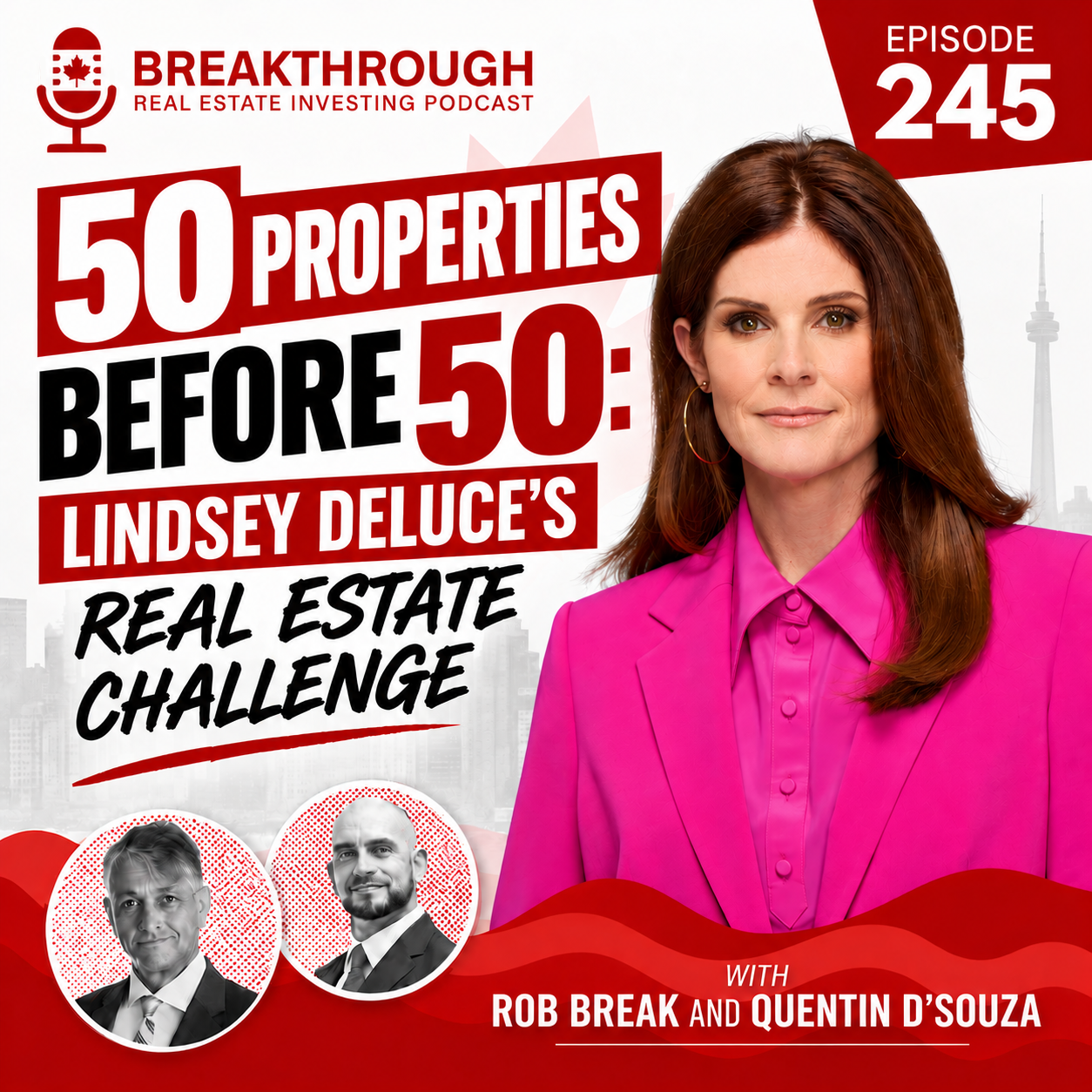
[00:08:32] Speaker B: Okay, let's do it. Well, we've got Lindsay Delouse on with us today and we're very happy to have you here. You've got some interesting stuff to share with us and Quinton's got a little bio to read for you.
[00:08:46] Speaker C: Yeah. So Lindsay is one of Canada's most respected broadcast journalists.
She's built a reputation as a trusted and credible voice in media. Behind the scenes, she is a seasoned real estate investor, building a substantial portfolio of multi unit properties across Ontario. Lindsay will soon take on a new challenge when she combines her broadcast expertise with, with her investor expertise to document her real specific time bound goal of 50 investment properties before she turns 50, while educating and inspiring Canadians to build generational wealth through real estate.
[00:09:23] Speaker B: Very good. Welcome. Thank you for coming on.
[00:09:26] Speaker D: Oh, guys, thanks for having me. I'm, I'm glad we found Quinton. I mean, you know what I love about your podcast is that Quinton, every time you're like, where have I been? You're like, Mexico, Scotland, Wales. I'm not sure if you time the podcast that you're, well, recording every, every time you're back.
[00:09:42] Speaker B: Yeah.
[00:09:43] Speaker D: Smoking cigars with your convertible. I want Quentin's life, Rob. What's happening here?
[00:09:48] Speaker B: Yeah, yeah, I think we all do. But you know what? That's again, that's one of the things that we try to focus on with the show is just like if you do things right, the lifestyle that you can build for yourself doing, you know, investing in real estate.
[00:10:01] Speaker C: 10 years of investing in real estate.
[00:10:03] Speaker D: Yeah, it's amazing. And you know what, and that's why I think you guys are both. Your voices are so great to listen to both of you. And you've obviously been doing this podcast, you're saying what, 12 or 13 years now you're at like almost what, 250 episodes or something close to.
[00:10:16] Speaker B: Yeah, yeah, exactly.
[00:10:18] Speaker D: Yeah. It's pretty incredible. And, and, and the diversity of the guests that you have on is. Is pretty great. And for somebody like me who. How did I figure out I wanted to be in this space? I. I was, I'm self taught. I had to listen to everything, read everything, talk to everybody. So finding, you know, podcasts like yours and, and similar ones, that. That's been my education. You know what I mean? It's reading all the things and, and learning from people who are in it.
[00:10:48] Speaker B: Yeah. And it is great because there's so much free information out there that never used to exist.
[00:10:53] Speaker D: Yes, agree.
[00:10:55] Speaker B: And now you can.
And people are so willing to share, which is what I love. You know, people like you coming onto the show and being. And being willing to share everything you've learned, you know, for free.
[00:11:06] Speaker C: That's quite a goal too.
[00:11:09] Speaker B: Yeah, absolutely.
[00:11:10] Speaker D: But I also want to emphasize I don't look at myself like an expert. I feel like I'm a professional student just working toward a goal.
And I'm okay saying that. I feel very comfortable saying that because once I start talking about the experience that we've had. Yes, I've had a lot experience that has been building on every moment and every deal and everything we've done for the last. What year are we in now? For the last 11 years.
But do I consider myself an expert? No. And for me, I don't want to be an expert. I don't want to finish. You know what I mean? I want to keep building on the knowledge that I have. I think I'm a. Well, even in my normal job, which I'm a news anchor for a national morning show and I've been waking up at 3:45am for almost 18 years, five days a week. I have more hours in my day than most people. So I had time to start thinking about what am I going to do with the rest of my day.
And then I started learning.
[00:12:10] Speaker C: That's awesome.
[00:12:11] Speaker B: Fantastic.
[00:12:13] Speaker C: Did you like when you started real estate investing, did you go out to meetings? Did you go out to like a boot camp? Or were you. Was it just the podcasts and reading?
[00:12:29] Speaker D: I read Rich Dad, Poor Dad.
Like so many people, I wish I had read it at 20, but maybe it wouldn't have saturated as much within me at 20. You know what I mean?
I was on a trajectory. Well, I didn't really start my media career until I was probably 26, 27 when I moved out to Halifax and started in a newsroom called Everybody that I could possibly get a number for moved out there in 2006. In late 2006, and said, Listen, I could give myself three months here, and if it's not going to work, then I got to go somewhere else. Because the advice I had gotten in Toronto was, you have to go make your mistakes in a smaller market.
My boyfriend at the time, husband, now was going back to finish his university degree. So I was like, you know what, Let me give it a go.
So I actually got hired at a radio station and I was doing news for 17 radio stations on the weekends. And ironically, that shift was also 3am I couldn't even wake up for an 11:30 class at university. And that's what was the joke of my family. Now, you know, I'm permanently up in the middle of the night. Anyway, I ended up working seven days a week because I got hired at CTV Atlantic. So CTV out there turning the teleprompter dialogue, which I did it for the anchor for 5 o' clock and 6 o', clock, which was Steve Murphy, an amazing mentor of mine in the business.
But I'm telling that story for a couple of reasons. One, that's how I got started in media.
And to sort of finish off that portion, I was always ready for the job that I wanted. Not the job I had. You know, dress for the part you want, not the one you have. And so I was constantly asking to be a reporter and somebody was sick one day, so they said, hey, Linds, can you jump in? And I did. I went to the Canadian Blood Services and I did a live rant on camera. And then I was on ever since.
So yet the reason I'm telling that story is because I did do the other jobs.
And when you're in real estate, you don't want to hand stuff off without knowing the other jobs. Is what I've learned as well with managing the properties that we have. I need to know that what a the furnace looks like. I need to know, like, how the roof operates. I need to know all this stuff instead of saying, oh, well, I'm going to outsource. You can get to a point where you want to outsource. And listen, I like outsourcing, but I also like knowing. I like details. I like information. The more information and the more you've sort of worked up the ladder, the more appreciation you have for all of the jobs it takes to get things rolling.
[00:15:02] Speaker B: Yeah. And I think there's something to the point that a lot of people say, well, you don't have to. First of all, there's the one cop out that I always love that people say is they've done all the research. You couldn't tell me. You don't hear this. People say, oh, I did all my research on all the markets, and it turns out where I'm living was like, incredibly great market for me to start it. And we've, I've heard that story a hundred times. Right, but that's, but, you know, and, and it's probably true because you can find good deals in the market that you're in. And that I find is probably the safer way to do it. A lot of people can. Like, I own, I still own properties in, in Ontario.
I haven't stepped foot in them for the last six years, which is incredibly uncomfortable for me. It's not the kind of thing that I like. So where you can invest in, in properties outside of where you live, I like that idea too. Where you can go in and know what it is, know what you have and touch it and, and, you know, understand the ins and outs of the entire place.
So I like that. I like that kind of thing too, is all I'm saying.
[00:16:09] Speaker C: Yeah.
When you, when you shifted to your real estate acquisitions, did you, did you use some of the skills that you picked up from the jobs that you were doing in media, in the, on the real estate investing side? Like, how did, how did that kind of, kind of go together?
[00:16:31] Speaker D: Well, I would say 100%, yes. My research background, with everything I do in terms of when I'm interviewing somebody or just for my job, I mean, I do the news every day. I have to read, I have to listen. And I. And also I enjoy it. Even when I'm finished work, I'm listening to podcasts to. I'm watching the news all day long. And that's not work for me. That's what I enjoy.
Same thing is true about real estate. And I didn't know it at the time, so that's what's also interesting. I didn't know that I would transition into this lane before I was in it.
And in fact, when I was out in Halifax. Oh, God, this would have been probably. I left Halifax in 2009, so it's probably around 2008.
And I was a young reporter at the time, young being new, I was also young.
And we got a request from BNN and BNN Business News Network.
There was a request for reporters right across the country to find they're doing a story on $500,000 houses across the country and what $500,000 would get you at the time. So I guess I was the one available. Didn't Know much about real estate. Went out with my camera, camera operator and we went to find, I tried to find a $500,000 house in Nova Scotia.
So driving around, trying to find, calling everybody, I end up at this house that was about $500,000. It had a basement unit for me, not knowing anything, we shot the whole story, sent it back to bnn and they said, nope, that's not going to work. That's not what we've asked for. We haven't asked for a $500,000 property with an income suite. We want a single family house. And for me, I didn't know the difference at the time. I didn't know that one was worth more than the other and that if you got an income generating property, blah, blah, blah. I didn't know any of that.
So I remember that that started like a huh moment for me, you know, jump ahead to 2015.
I'm now married to my husband, who is a contractor. He's got his own business. We're sitting around the table with my brother, my dad and my mom, my siblings, and my brother actually turned to all of us and said, you know you're sitting on a gold mine, right? I said, what do you mean? So. Well, your husband Drew. Drew builds houses, he does this. You love the business stuff. Why don't you guys flip a property? Why don't you just try?
So within two weeks, found some money through family money like we found, we got some family saying, listen, do you want to pitch in on here? We pitched in some and we bought, we bought our first property and we turned it around about eight months. And as that was happening, word on the street that we were doing this. And so somebody said, hey, I know these people that are, that are selling their place did. They don't want to go through the proper channels. They didn't want to hire a real estate agent, so they want to sell private.
So we ended up in eight months flipping two and then we were off. And that was 2015. And we did that solidly until, well, 2020.
[00:19:29] Speaker C: So you were flipping. How many properties would you say that you flipped in that time?
[00:19:35] Speaker D: About two a year. We had three on the go at one point, all in Toronto.
So there were probably about 11 or 12.
[00:19:46] Speaker A: Wow.
[00:19:46] Speaker C: And there was a lot. Did you make like, were you making coin or like, how did that.
[00:19:52] Speaker D: Yeah, that's why we kept going.
In my head, I had in my head my spread was a million dollar spread. But these were. We started to get more elevated and more into the luxury real estate space.
But if I, if we bought at one marker, I wanted to be able to sell it at a million more. And then with all the expenses and everything else in. But if we had done that spread, then I knew that we were golden.
[00:20:15] Speaker B: Yeah, I guess so.
[00:20:17] Speaker C: True.
[00:20:18] Speaker D: These were like, these weren't. It was, it was, it was, you know what the market in Toronto was like from 2015 to 2020. It was on fire. Multiple offers, Bully offers were going for $300,000 over asking. You know, we were in a space where we kept rolling. We learned a lot. Obviously there were some failures, there were some mistakes. We started to get too expensive in what we were doing. When I look back now and analyze sort of some of the finishes we were putting in and we did a full edition when Drew and I look back now and I think that wasn't the smartest move.
Broke even on that one. So there, there was a lot of learning in there, but that was a, it was a hands on approach.
[00:21:00] Speaker C: Yeah, it's an interesting time too because I, I remember I was, I did a couple of flips at that time too in Toronto down at Cogswell and Gerard area. And we didn't even, we didn't even actually do any renovations. We just cleaned it out. We put all the plans on the wall and we put like a whole bunch of like wood in the basement and we said, oh, the contractor didn't want to finish and we flipped it and we made money.
[00:21:28] Speaker D: Quentin, where Were you in 2017?
We went back to the studs on these things. We did full. Everything, absolutely everything because we thought we had to because again we were just learning as we were going.
And then it worked until it didn't. And then 2020 hit and we got called on some margin calls and investors wanted their money back. And it was, that was probably. I've never been so stressed obviously in my life. We ended up selling one for way under. Losing money on that one. The other one was mid renovation, which I've learned. Trying to sell a project that is not complete when you need a cash buyer, very challenging. Especially in the first, you know, it was like, I don't know, July 2020, not even maybe May 2020. That was very challenging. Yeah. So we took a break. We took a break. We had to.
[00:22:22] Speaker B: And that was when you decided a different, to go with a different type of investing.
[00:22:27] Speaker D: Yeah, we did.
So cut to two years later.
We, we took. Well, we were breathing for two years because that was, that was quite a time. That was.
[00:22:37] Speaker B: So you didn't have any hold Properties at all during this time.
[00:22:40] Speaker D: No, no, no. We did not just.
I know, I know you know, you. I'm sure you guys as well, when you look back at the trajectory of your investing and your style and you know, how it's evolved over the years, would I do things differently? 100%. But I have to tell myself I didn't know what I didn't know.
You know, I didn't know what I didn't know. And so I can't beat myself up over it. Even though there's like one property in particular I still think about. I cannot believe we sold it.
So I got to get over that because we should have held onto it and just rented it out.
But those are the things that I said, well, I don't think I'd be where I'm at now if I hadn't gone through the process of the evolution of our real estate investing.
[00:23:26] Speaker B: Okay, so you didn't give up completely. You just took a little break. You said, I need two years to exhale.
[00:23:33] Speaker C: Yes, but you still made money before that, though. Like, overall. Overall, you're still.
[00:23:40] Speaker B: And you learned.
[00:23:44] Speaker D: So then, Then I wanted to get into the space of buying and holding, doing the. The brrr method, and which I'd been, you know, for so 2020. I turned 40.
So that's when I picked up rich dad, poor dad.
It's all making sense now, right? No, I picked that up. I'm like, how am I going to do this?
How am I going to do this? I've got three kids, everything's expensive.
We're in panic mode because this is happening with the pandemic. What am I going to do? I like problem solving and I like strategy.
As we were exhaling for two years, I was trying to figure out what the plan forward was going to be.
The more I talked about it, the more I read, the more I listened to it. Came down to, okay, the next one we get, we need to hold it. We need to do minimal renovation. We're not doing what we used to do. Let's just make it comfortable and livable, and let's see what happens.
So in about 2022, I was on assignment. I went to Kingston, Ontario, on assignment for ctv, and I was doing a segment on some sort of tourism thing. I had gone to Queen's University in Kingston, and I knew that one of my old acquaintances there, Andrew Kilty, A.J. kilty, lived there, and he had done really well in real estate with Varsity Properties, and he had started right out of the gate, which I didn't know about, but I said, listen, I'm going to call him up.
And actually it was, I was going to message him online and say, hey, can I grab a coffee? Anyway, he invited me over for dinner. I met his beautiful family and I said, I chatted with him for a while, but how he's, you know, what his successes have been and all of that over the last 20 years. And he said, what are your goals? And I said, well, I'd love to have, at the time I was 42, I said, I'd love to have five units. Five, five units by the time I'm 50. And he kind of paused and he looked at me, he was like, five. He's like, why not 50?
He said, what's, Lindsay, what's the difference between having a property with one toilet and a property with 10? I said, what do you mean? He said, well, you're putting the same work in.
The property is the same, your management is there.
There's no difference except you've got a greater revenue stream, more income and there's that. So why wouldn't you do 50? And I walked out of his house that day and I went, I'm gonna have 50 by the time I'm 50.
That's my goal.
And here I am.
[00:26:17] Speaker C: Nice. That's awesome.
And I think, like, if I'm not mistaken, Varsity Properties also does like apartment buildings and stuff in Kingston because we, we've got a bunch of buildings there. So I see, I see a few of the different operators in that, in that area. I've never, I didn't know, I didn't know him personally, but I just seen his name on the different buildings when we've gone to solicit purchases. It's funny.
[00:26:47] Speaker D: And I don't know if he knows that he was the start of my goal setting, so.
Yeah, you should tell him.
Well, I plan to on my new podcast called 50 by 50.
I'm going to hopefully have him on and I'll let him know that he was the sort of the, the colonel that got this started.
[00:27:06] Speaker B: Yeah, tell us about that. Have you, have you launched the podcast yet?
[00:27:10] Speaker D: We are booking guests right now. It's been in my brain. I have this thing, I guess I have a two year hold in my brain where I just think about things because I've been thinking about this for a long time and honestly, what the podcast really is, is what I'm doing in my normal life anyway, which is talking to people who are in this world and saying, hey, what's your story? I love People's story and how they got from A to B and, and where the, where the left turns, where, where the right turns were, where the wrong turns were, where the U turns. Like I love all of, I love the story to get where you're going and also the practicality and the practical knowledge from people who have, you know, two properties or four doors or 100 or a thousand, whatever it is, it's all so fascinating to me. So I'm doing that anyway. So basically I'm just porting that experience that I have in my real life and asking people to come on and chat with me on a more public forum.
[00:28:02] Speaker B: Very cool. When do you expect to have it launched?
[00:28:05] Speaker D: January.
[00:28:07] Speaker B: January.
[00:28:07] Speaker D: January.
[00:28:08] Speaker C: Awesome. You'll have to let us know when you, when you put it out and we'll, we'll put it on our social media.
[00:28:13] Speaker D: You guys have to come on.
I'm used to asking the questions, so this is an interesting format for me.
[00:28:23] Speaker C: Well, that's interesting. So I'm glad. We're happy to. I'm sure Rob is. And I'm happy to come on and.
[00:28:31] Speaker B: Absolutely. Anyway, can we go back a little bit now then to what was your first purchase for a hold and how did that play out?
[00:28:42] Speaker D: So I'll tell you where we're at right now. So we have 23 doors.
So I'm halfway to the goal. Drew and I should say Drew and I are halfway to the goal. And we purchased.
We have three short term rentals and so that had us at four units. And then last year we went from four to 23.
How?
Well I learned about commercial lending.
[00:29:08] Speaker B: Oh, very good.
[00:29:10] Speaker D: Yes.
My aha moment. I was like, wait, what?
How is. Wait, what? Okay, that unlocked, obviously that unlocked a thing for myself. Yeah, it was, it was the, it was the news I needed and wanted to hear. So then I started looking for a multi unit building and I had sort of two focus areas. We had gone up to Sudbury as one of our target areas and done a lot of market research there, met with real estate agents there, drove around a little bit.
So that was one of my target areas. And then we're very familiar with just east of Toronto, like the Port Hope, Coburg, Colburn area.
I spent, my husband and I both spent time at, at school in that area.
So a real estate agent of mine, she sent me a listing for a building in Port Hope. So I said, okay, let's go. We ran the numbers before I went. They looked pretty good.
So went out there, looked at it, came back, it looked great. And then so we just said, okay, well, now we're going to have to see if we can find money. We've got the property, now we need to find money. As that was happening, one of Drew's business partners was in the room with him, and he was like, hey, we've got some money. We want to invest, and we've been looking for a multi unit. I was like, okay. So in the room at the right time with that conversation, we got two. Two of Drew's business partners involved. So there's four of us.
And turns out that that property that I was looking at, the owner of the property, the seller had a bunch of different properties they were trying to offload. So there was another property that was of interest. And so we ended up in the one transaction, buying two.
So the one in Port Hope and the one in Colburn. And we got a good deal because we had a package deal.
And that was a year ago.
[00:30:59] Speaker C: Was that person Sarah?
[00:31:02] Speaker D: Maybe. Or maybe not.
[00:31:07] Speaker C: No way. That would be so weird if it was Sarah Copeland. That would be funny. Okay.
[00:31:16] Speaker B: Just like, you know, I'm not trying to burst your bubble or anything like that.
Well, it's not in a bad way. So, you know, I've got a new goal for you. 27 units in 27. Now your. Your. Your podcast name is already, like, toast.
[00:31:33] Speaker C: Yeah.
[00:31:34] Speaker B: You know, so 27 units and 27, that puts you to 50. You're gonna have to change it to like 500 by 50 or something.
[00:31:41] Speaker C: 500. What's the next shot?
[00:31:43] Speaker D: Are you ready? You ready for this? Because I anticipated this.
[00:31:46] Speaker B: Right.
[00:31:46] Speaker D: 50 by 50 is, yes, my goal, but 50 by 50 is a concept, a movement of goal setting, especially for, you know, the women I talk to in my life. And those that are. Feel like they're done after 50. And I'll tell you, those are conversations that are happening. And to try to start a second career or if you had an idea and you've been in a job for 20 years, and all of a sudden you're 50, you're like, oh, I feel like I'm too old. This marker of 50 by 50 is. Is just the beginning, and I hope it. I hope that it expands it to more of a conversation about how do you set a goal? What's the one thing that you've wanted to do for 20 years? And you've been riding that nine to five. How do you get out of that? So my 50 by 50 is. Was my goal. What's your 50 by 50?
That's the transition out of the 50 by 50.
It's a concept. Right.
[00:32:37] Speaker B: Because you know, now you've realized that it could be as simple as tomorrow. You guys are into a 27 unit building.
[00:32:44] Speaker D: Sure.
[00:32:45] Speaker C: And.
[00:32:45] Speaker B: And you're already have one.
I don't baby. Sarah has another one.
[00:32:50] Speaker C: I just sold.
Yeah, I sold three buildings recently. Two.
Two was like a hundred. No, no, it was, sorry, 40 units.
So. And then we just sold another 20 units.
[00:33:06] Speaker D: So why'd you sell?
[00:33:08] Speaker C: We had, we had actually no, I'm interviewed here. This is interesting.
[00:33:12] Speaker A: Yeah.
[00:33:12] Speaker D: The table stirred.
[00:33:14] Speaker C: So we what, we added two units into the building. We converted some of the storage into new units and we've turned over a majority of the building and we just wanted to take cash like we wanted to get a return because we've been investing for a very long time and for me getting like a million bucks out of the, the portfolio is nice because now I could, I'm in a different, I'm in a different place.
[00:33:45] Speaker B: Right.
[00:33:46] Speaker C: So I'm looking to convert into income. So I do a lot. Like I'm, I'm investing in other businesses now. I'm also investing in some private lending and I also do like public equities, private equity. So I'm kind of doing other things as well.
So that was part of the reason why I was selling. But there, there were good buildings. We still own six other buildings in Kingston in the same area.
Yeah. So. And I, I would say if you're, you know, if you want to expand on the building side, like secret Kingston is mostly buildings, like it is a good opportunity there.
[00:34:27] Speaker D: So can I ask both of you this question then? If you were me sitting at 23 right now, what would you do?
What would be your move at this point to try to get to that goal?
[00:34:38] Speaker B: My answer is completely different because I've like.
So basically six years ago I, I moved to Costa Rica. I haven't even really been back to Canada very much at all. And, and I started selling off a lot of my stuff.
So I've just been doing different projects down here.
We, we did a build. We.
We owned a boutique hotel for a little while and we just recently bought a gym in this town.
[00:35:06] Speaker D: I heard. How's that going?
[00:35:08] Speaker B: It's cool. It's cool. I love it. I mean I, I like hanging out at the gym. So it was kind of a no brainer. It's a, it's a lot of fun and going well. So I mean I, I've just like totally simplified what I'm doing and, and, and the new goal as Stupid as it sounds, maybe to some people is how can we be reasonably happy and get by and, and not. I don't think that I'm not building a portfolio anymore. Really.
[00:35:39] Speaker D: Yeah.
[00:35:40] Speaker B: So we've still got a couple of properties in Ontario, but I'm not growing, I'm not growing it right now especially.
[00:35:47] Speaker C: Yeah.
[00:35:47] Speaker B: So my answer isn't going to help a lot of people get.
[00:35:52] Speaker D: No, but I, I think what it does, Rob, though, is it, it talks, it speaks to the fact that you, you do resets like we all do resets every couple years. Right. And we just, we assess where we're at and then we have to make, we make adjustments based on where our head's at, where our family's at, where our bank accounts are. We just adjust in order to create more value in our own lives.
[00:36:13] Speaker C: Yeah, I think, you know, kind of like a correlation to why I sold those buildings is my, my, my brother passed away recently, last, you know, six months.
And I just like, you know, I'm, I'm building, building, building. I need to also enjoy what I've built, hence the car and the trip and you know, just making sure I'm spending time with my kids on these trips, like going like when we, when I do a trip, oftentimes I'm taking one of my sons and we're doing a trek together in the middle of nowhere, like West Coast Trail, Inca Trail, like Everest Base Camp, that sort of stuff. So I think that's, that's part of it for you. What I would say is that I would scale on the commercial side. If you, if you, if you, you can do 500 doors in the same amount of time as you do 50. If you are looking at commercial and you have, you do the same strategy, the burst strategy with the commercial units, especially if you, if, you know, with your husband and their, in his expertise. And I would, I would leverage being able to add additional units into existing buildings because the cap rate like multiplier is so high. So I'll give you an example. I've got a 12 unit in Oshawa where I'm adding two units into the basement right now. Those two units, because of the size of the units and where they are, they're probably going to get 2,000 each.
So I'm raising $4,000 on the, you know, maybe net it'll be like 3, 800. But even on, on that, the raise in building value is close to a million dollars. My cost to build is probably about 300. So the. Right, so where I see your Husband really helping with is those like fine buildings where you can add units and, and that way you're not worried as much about the turnover. I mean that, that's a bonus. But the adding units, where is where your strength is going to be because of the, you have experience on the flipping side. And then it's about managing the whole process because dealing with cities and adding units, you'll have to do variances, minor variances, all that stuff. So. But yeah, that's where I see. I think for you that would be super awesome.
[00:38:52] Speaker D: Yeah, I know we, you know, I mentioned off the top that we've got these three short term rentals. There's one that we're re evaluating actually this week. We're thinking, you know, I think our money could be better used in more of what you were just talking about and to continue on that path of buying these, these rentals. The short term rental, you've got one in Meaford, it's fine but it's more of a headache at this point to be honest.
And we're not, we're not generating the, the revenue that we want.
So I think, I think that money can go further elsewhere.
[00:39:23] Speaker C: So yeah, do, do a return on capital calculation on your portfolio on each asset and when you, when you look at like your cash flow, even if you want to include mortgage pay down, doesn't matter. You're like on an asset that you've held for 20 years, you could be like 1 or 2% return on capital, which doesn't make a lot of sense. You wouldn't have bought it for that reason.
[00:39:47] Speaker D: Right.
[00:39:48] Speaker C: I know like you could, you could do better on a gic. So why would you do that? Like, so that's when you go back and.
[00:39:55] Speaker D: Yes. Yeah.
[00:39:57] Speaker B: I have a question for you, Quentin.
[00:39:59] Speaker C: No, no, no, we have a question.
[00:40:00] Speaker D: Yes. No, we've got Quinton questions like because,
[00:40:04] Speaker B: because you probably you, you have a more insight on this.
How, what, what kind of percentage of the buildings that you look at do have that potential to add units.
[00:40:15] Speaker C: Not every building. That's, that's what makes it unique. So I would say maybe one out of 10 would have that and you have.
[00:40:21] Speaker B: So one out of 10. That's not bad though too. That's pretty good.
[00:40:25] Speaker C: And you have to be creative. Like some usually like it's space that you would never normally think. So like you're taking out. So this one is a basement and the height was a problem but they changed some of the rules so now I can do it. But like the other time it was taking some of a laundry room out and then moving the laundry over. And now we have a whole bunch of space that we can use. Because the laundry room smack in the middle of nowhere, like it doesn't make sense or you know, we had the st. The like on each floor.
Tenants were using it for storage and like it was basically a bachelor size unit. So we made them into bachelors. Right. Like, so that's a sort of create, like that's, it's just being creative. It's just like what you were doing with Flip.
But you're, you're just kind of engineering units in the space that's there. That makes sense. Right.
I think that's, that that will probably give you the largest bang for your buck in the shortest amount of time. And if you do it with like you, maybe you start off with conventional lending and then on the finish of the construction you move to cmhc, then you'll, then you're, then you'll be able to pull out almost all your capital and do it again. I just don't have the, like, I'm not, I'm in a different place now. We've got 500 units. I like, I'm not in the place where I, I feel like I need to drive as hard as I did before. But if I was starting again, if I lost it all and started again, that's what I would do. I would do like all day. I would do that. I'd be underwriting buildings looking for that opportunity and just that alone on the. Let's say it's a 12 unit building. A million lift. That's all your money out.
[00:42:13] Speaker D: Yeah.
[00:42:14] Speaker C: On a 10 or 12 unit building, like that's most of, if not all. So if you can do that, I mean it's a very kind of narrow. Yeah.
Anyway, sorry. I got excited. This is supposed to be stuff.
[00:42:28] Speaker B: That's all you're excited?
[00:42:30] Speaker A: Yes.
[00:42:31] Speaker D: I could listen to this kind of stuff all day and in fact I do. So I just became a listener for a second. I was like, what we're going.
[00:42:38] Speaker C: When we do your podcast next year, we'll talk about this.
[00:42:42] Speaker D: I'll have lots of questions. I'm holding myself back for nothing.
[00:42:45] Speaker C: So how do you manage two careers?
You're prioritizing between the two? I assume. So how do you manage that?
[00:42:55] Speaker D: I don't know because I wake up really early.
I think it's that simple. Like how many more hours in the day do you get? And I'm not. I wake up at 3:45 in the morning. I have to, because I'm at work at 4:30.
Well, our first call is at 4:30. I'm on air at 6am straight live for three hours until 9am and then there's some post show stuff that we do. Meetings and we chat with producers and we look ahead to the next day. But I leave my work there because that's what's, that's what's, I guess, so different about the line of work that I'm in and the career that I have because I'm. Because I do live television, I do the news. It's constantly changing.
I leave that portion of my day. And then as I told you earlier, I just, you know, I'm always listening and reading and so I'm doing that for the rest of the day.
And I just kind of pivot that into this other, this other area that I really, really love. I really love real estate. I really love investing. I like the puzzle of it all. I like making money. All of those things, like, are kind of like a perfect combination for me because I'm doing two jobs that I love. Now. Am I exhausted? Yeah, there's some times when I think that I should slow down. But then I remember in my twenties, I'd sleep till like early twenties, I'd sleep till like 1pm so I rested up back then.
Now I'm full throttle and I wouldn't have it any other way. And interestingly, and probably like you guys as well, I tend to surround myself. I'm not purposely surrounding myself, but with all of these really exciting people who are doing really interesting things. When you have these conversations, women and men, about what they're doing and what's exciting and what do they love about their life? I'm just talking work, I'm talking anything, right? To your point, Rob, like you figured out, hey, where am I at right now? What do I value the most right now? Like, what do I want to do for me, what do I want to do for my family?
That stuff's exciting, right? Those are your story and Quintin, your story.
Nobody else has those stories or that perspective. So just talking to people I find is so fascinating because everybody comes at it in a different way. And that's why even with this real estate investing world that we're all in, there's no linear path. And that's what's so interesting to me. I don't know. Correct me if I'm wrong, but can you go and just, can you go and just study how to become a real estate investor at School, Are you like, I don't know if you can do that?
[00:45:21] Speaker B: No.
[00:45:22] Speaker D: Right. Like, it's not. There's no.
There's no direct path. So you have to figure it out. I come from an entrepreneurial family. We always were having conversations around the dinner table about, oh, you know, what's. Where is dad? Like, what continent is he on? And, you know, is he coming back with jeans from somewhere else? Being like, how do we sell these? You know, like, this was a constant. All my siblings are entrepreneurs, so I've been surrounded by this my whole life. So I just kicked it into high gear in the last, you know, six, seven years, really quickly.
[00:45:50] Speaker B: I'd like to ask you because it is interesting to see the different perspectives of what people, what challenges people have run into and how they've overcome them. So I'd like to ask you that question because sometimes it's the financial piece that people find most difficult. Sometimes it's finding the deals that work, and sometimes it is the renovations themselves going wrong or whatever, or tenants. So for you, what has been the biggest challenges?
[00:46:19] Speaker D: Financing.
[00:46:20] Speaker B: Financing.
[00:46:20] Speaker D: Financing. That is the number one thing that was holding me back from doing anything. I still am nervous about it. I'm nervous that I'm not going to find the money. I'm nervous. I don't know who to ask. I'm nervous. I don't know where to go. But I will tell you that I've had this. This mantra for the last while, which is there's always a way. I've heard no.
I've heard no a lot in my life when I come up with these ideas and I approach banks and I approach.
I've heard no from everybody. And then I just sit back and, yeah, it sucks, but I go, okay, there's always a way. And guess what? There actually is always a way. And you just have to figure it out. Like right now, we're going through a refinance of something, and it's like, actually, every deal that we've done, there's been major problems about the transaction. And we've. And it's kept me up at night. I'm panicked. Just figure it out. Sit down, come up with a strategy, Be calm and figure it out. So the financing portion, and I'll tell you, from the people that I talk to, I post a lot recently online, about which I was a little. I was apprehensive about posting on social media about what we've been up to.
I talk a lot about it to people in real life, but to put it out there on social media saying, hey, this is the other part of my life I was kind of nervous about because I felt a little bit exposed.
But what I have learned, as uncomfortable as that, is to put out the number of people that have come to me, messaged or had a coffee, like asked for how to have a coffee with me about, hey, I would love to do what you're doing. I just don't know where to find the money or I don't have the money.
And that seems to be a general thing. It was my theme too. Like I was trying to figure out how I was going to do all this.
And I would hear constantly from, you know, these webinars I'd go to, there's so much money out there. There's so much money out there. But I was, I'd be yelling at my be like, where is it? Like, how do I find it?
And what I've learned is that there's always a way. I just got to find it and I got to talk to people and I got to, you know, I got to go through the networks that, you know, like, I know your, your Durham network is probably really great, which I'd love to, to come out to one of your Wednesdays. But really just showing up, showing up and talking to people and see what people are doing. I was at one recently where I'm going to have a sit down with a potential lender. But I got to put yourself out there, which is what I started to do. Even if it's uncomfortable, even if you don't think you should be there, even if you have imposter syndrome, which I know a lot of people do, you're there for a reason. You'll figure it out.
[00:48:47] Speaker B: That's amazing.
And it is, it is. Well, I just want to say thank you so much for coming on the show again. We really appreciate.
[00:48:57] Speaker C: Went so fast. Holy.
[00:48:59] Speaker D: So fast. That was great, both of you. Yeah, thanks for having me. I do really appreciate it. It's all, you know, listen, I would, I, I listened to you guys. So to have you in real life, I got caught a couple times in the last hour staring and just listening because I thought that I wasn't on the show.
So this, you guys add so much value to people like me in this space. Learning, growing.
So thank you, both of you.
[00:49:23] Speaker B: That's awesome. Thank you. How can people reach out to you?
[00:49:27] Speaker D: Well, social media, as I mentioned. Lindsay deloose. I'm Lindsay with an E L I N d s e y.deluce d e l u c e also 50 by 50. I've got a social media account for that. It's the 50x, f, I, f t Y. It would have been the number 50, but somebody else took it.
If you want to email me, it's also Lindsay50x50CA and of course LinkedIn as well. And look out for the podcast that's coming up. 50 by 50.
Can't wait to have both of you on.
[00:49:56] Speaker B: Yeah, that's amazing. And we're going to have all of the links in the show notes, so anyone who didn't have a chance to write that down because you're driving or whatever, go to the show notes and all the links will be there.
Quinton, how can people reach out to you?
[00:50:10] Speaker C: Yeah, you can go to quintindsooza.com I'm happy to talk with you for 15 minutes about real estate. If there's something I could do to help you, then I'll put you in the right direction. Happy to do that. Or you can come out to Durham rei, second Wednesday of the month next week. We've got some great speakers again. And, you know, it's a good group of people. We've been doing that since 2008.
For 18 years we've been meeting, so it's been. That's been cool.
How about you, Rob? How can people get a hold of you?
[00:50:42] Speaker B: Just email me. Robisterbreakthrough ca.
That's the best way.
Awesome.
I was gonna say, like, Quinton. So what you're telling me is that right there during that show, that was amazing information that you gave everybody?
So what you're trying to tell me is they can go in, they can book a 15 minute call with you and ask you a specific question that they need an answer to and you'll try and help?
Is that what you're saying though, is it?
[00:51:12] Speaker C: Yeah, I'm happy. I don't mind giving people 50 minutes of my time.
[00:51:16] Speaker B: If I can help somebody, that's pretty awesome.
[00:51:18] Speaker C: I can help somebody. I'm happy to help them, but like 15 minutes, that's 15 minutes.
[00:51:25] Speaker B: Quinn hangs up on the 15 minute.
[00:51:29] Speaker C: Like, so, like my wife is calling me.
[00:51:32] Speaker B: I got a really loud countdown comes over the. Over the call.
[00:51:36] Speaker C: No, but I'm happy to help. I want, like, honestly, this is small. I know it seems like it's big, but it's a really small group of people, like all over the place. And real estate investors know other real estate people.
Like Lindsay was saying Varsity, she mentioned two properties and I could have. I could have sworn it was Sarah but whatever it may not have been, there's, you know, there's all these connections out there, and we are so interconnected anyways, we just don't know it. So I just want to make sure to leave a positive mark on, on the world, you know, as best as I can. And, you know, Lindsay had a great saying. My saying is, if it were easy, everyone would do it.
And real estate isn't easy. But the more that, you know, we can help each other, I think that it makes it a little bit better. And you don't have to be like everybody else to be in real estate. So that's it.
[00:52:33] Speaker B: I remember one of the first shows that I used to listen to when I was, when I was trying to learn about real estate was Sean Terry. I can't remember the name of the actual show, but he had a podcast and he taught wholesaling. And one of the big things he always used to say, I'm going to leave my little bit of advice here, too, is when you, when you're trying to reach a goal, go over, under, around, or through the obstacle to get there.
So I thought that was pretty great.
There's mine.
[00:53:02] Speaker C: That's awesome. But anyway, Lindsay's gonna be a 50 probably in a year. I. My guess is a year she'll be at 50, but that's my.
[00:53:11] Speaker B: Anyone's got a 27 unit building for sale?
[00:53:16] Speaker C: If you would have talked to me
[00:53:17] Speaker B: a month, we'll get you there.
[00:53:18] Speaker C: I probably could have helped you out, but.
[00:53:22] Speaker B: All right, well, thank you very much and thank you everyone for listening and we will see you next time.
[00:53:27] Speaker C: Awesome. Have a good one. Take care.