Episode Transcript
[00:00:01] Speaker A: If you're looking for the skills and tools to succeed in real estate investing, you've come to the right place.
[00:00:08] Speaker B: This show is about breaking through barriers,
[00:00:10] Speaker A: breaking through limiting beliefs, and breaking through to the life that you want to live through the power of real estate investing. You're listening to the Breakthrough Real Estate Investing Podcast. And now, here are your hosts, Rob Brake and Quinton d'.
[00:00:25] Speaker B: Souza.
[00:00:29] Speaker C: Welcome back, everyone. Thanks for joining us again. It's going to be an exciting day today. And of course, we've got Quinton, just fresh back from the gym, looking all.
[00:00:37] Speaker A: Yes, thank you. You too. I'm doing well, sir. It got back from the gym. Got back from Italy, too. I was doing the Altavia one with my youngest son just outside the D.O. outside of Venice in the Dolomites there for you.
10 days. It was fun.
[00:00:56] Speaker C: Yeah, I saw that on Instagram. Hey, anyone who's listening along should go over and check out Quentin's Instagrams because it's got a lot of cool stuff on there.
[00:01:05] Speaker A: Thank you. Yeah. Q, man, rei. I also do a little bit of daily. Sometimes I do some walks when I get inspired.
You know, I was, I was just sharing how I was underwriting a business that I was buying and kind of going through those numbers. So that was the. That was cool. Thanks for that shout out there.
[00:01:24] Speaker C: Yeah, I saw that, too. That looks interesting.
[00:01:27] Speaker A: Yeah. Hardscaping company outside of Ottawa. So I'm taking a position in IT as a passive investor. But, you know, if, if I need to, to provide any help, I, I would, but that's not the point in this one. And it's more of a.
I'm looking from a cash flow dividend perspective of this particular company and growth on multiple exit in a few years. So I'm, I'm looking forward to that.
[00:01:58] Speaker C: That's.
[00:01:59] Speaker A: That's something I would like to expand more of, just buying into different businesses. I'm have a couple more underwriting that I'm doing right now, so that's going to be interesting for me. I think this, this is a kind of a different evolution because I have so much real estate right now. I think for me, this is something that I want to grow. So, yeah, it's. It's different, but the same in some ways because I'm underwriting it.
You just have to underwrite it differently because you're dealing with ebitda, but there are a lot of similarities. So it's, it's pretty cool.
[00:02:37] Speaker C: Yeah.
[00:02:37] Speaker A: How about you?
[00:02:38] Speaker C: A good, exciting new venture?
[00:02:41] Speaker A: Yeah, for sure.
How's your how's your vibe? How's your vibe coding going? I've. I've been going nuts with this vibe coding stuff, man.
[00:02:51] Speaker C: Yeah, me too. I've been doing a couple of things. Like I told you, I built that gym membership system, and so I've just started with my guy, actually. We're gonna try and market it to some other gyms and see what happens.
We're in, like, obviously, very early stages, but we've been using the software at our gym, and it works, like, beautifully, so.
So I figured why not put it out there and see if anyone else is interested in it?
And literally just two days ago, we decided to go that way. So we set it all up and had a little bit of a marketing plan going on, and so we'll see. Hopefully it goes well.
And then the gym, of course, is running excellent. We've got a lot of really good members. And, of course, coming into rainy season, we see more people in there on a daily basis, so it's exciting. Going well, and we're managing some places down here, some airbnbs and stuff like that. Of course, helping people from Canada and the U.S. and everywhere to purchase properties here. So it's just chugging along.
[00:03:55] Speaker A: Yeah. It was fun visiting you down there. It was. I had a great time, and I, you know, like, working out with you at the gym, you know, it was. It was hard keeping up with you, but that's okay. I know you're. You know, when he's doing those curls, he's so intimidating.
[00:04:12] Speaker C: I don't think we mentioned this before, but when you were like. You were like, oh, let me buy some. Like, there was, I don't know, protein cookies or something like protein bars. And Quentin's like, let me buy one for everybody in the gym. And he starts going around with them and trying to give them to people, and everyone's like, I didn't know what to do.
[00:04:32] Speaker A: I was. I was trying to help you out.
[00:04:34] Speaker C: Sell them to me. Are you trying to give me one? What's going on?
[00:04:38] Speaker A: I was trying to be a nice guy and give you some sales and stuff like that because you wouldn't let me pay anything. So I was trying to help you out, and I was like, a creepy gym guy all of a sudden.
[00:04:51] Speaker C: Yeah.
[00:04:53] Speaker A: The women were like, what? Like, who are you? Like, what are you doing? Go away.
[00:04:59] Speaker C: Thank you for that.
[00:05:01] Speaker A: Oh, sorry.
[00:05:03] Speaker B: There it is.
[00:05:04] Speaker A: We should. We should get to our guest here, man.
[00:05:07] Speaker C: One minute. We're gonna get right to our guest, but everyone listening should go over to breakthrough reipodcast.ca and hook up with all the people.
Not hook up, but you know, speak to get in touch with all of the people that we've had on the show in the past and you know, you can, that's your gateway to get in with them, learn more from them and also listen to all the past episodes that we've had up on the show and, and go over to itunes, of course and leave us a rating and review. It helps us. Thank you very much.
Now we can get to our guest.
[00:05:41] Speaker A: All right, I'm going to give us give a shout out to Paul.
I think I've known Paul for a couple of decades.
I met him actually because he was in Real Estate Investor magazine and just like how I normally do things, I kind of reach out to different people doing different things and I believe.
Did you come out to Durham REI and do present? Yeah, but it was like decades ago.
[00:06:09] Speaker B: It was like 20 years for sure.
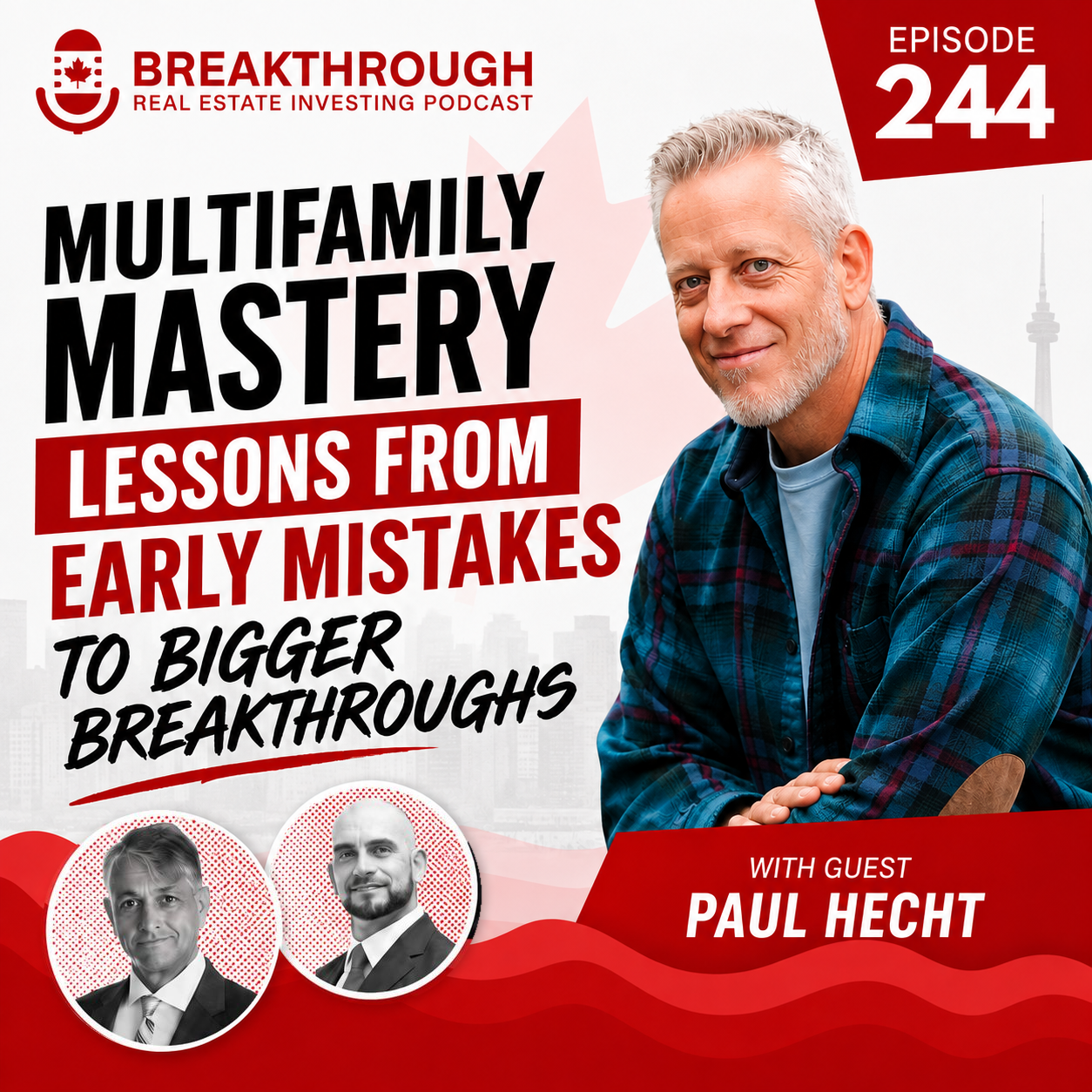
[00:06:11] Speaker A: Yeah. So I mean, you know, that's, I guess this is the business, right? We kind of interact in different ways in different times. So he's a best selling author of Everyday Real Estate Millionaires How Average People Really Do It.
Canadian Real Estate Wealth Magazines, Ask the Expert. That's right, that's what it was. And CEO of the private equity real estate fund PHDMFT and founder of the Canadian Multifamily Blueprint Apprenticeship program.
So for 25 years, Paul has been empowering individuals with the knowledge and confidence to create lasting financial security through practical, well selected real estate assets and has taught over 11,000 Canadian real estate investors over the past 25 years. There we go. That's Paul.
[00:07:05] Speaker C: Thanks for coming on, man.
[00:07:06] Speaker B: My pleasure, my pleasure. I always love talking to fellow real estate investors and you know, you, you hit an important point there. Quinton.
When we all start, we all start reading books. We get tape cassettes way back then. And then we try and mingle with other people and really the best way to do it is the investor clubs, going and meeting other investors, seeing what they're doing. And so you've been doing your club, I don't know how long, 20, 25 years or something.
[00:07:36] Speaker A: Since 2008.
[00:07:39] Speaker B: Yeah, I mean it's such, I don't think you probably recognize how supportive and how helpful it is for a lot of people when they get started to be able to go and see, hey, there's other crazy people out there who don't want to work a 9 to 5 job and they actually want to, you know, they're seeing that their RSPs aren't working or they're seeing they're not getting there fast enough. And there's other people out there who actually believe that and see that and you know, they, they go, okay, maybe, you know, my parents did it, okay, but I'm maybe not going to make it. Or I got to find other ways because all these pensions are going away and everything else. So it's such a supportive environment for investors. And so I always appreciate supporting investor clubs and meetups and anything like that where I can now be on the other side now contribute to, you know, the ones coming up in the ranks, so to speak. And, and you know, just the fact you've been around 20, 25 years speaks to your, to your dedication to that and a learning. You know, I find we're all learners, you know, and I think the minute we think we're not students anymore and we know it all is like the minute we're done, we're going to get hit and slammed with a deal because we get too arrogant. Right? So, no, it's such a good environment to continue and contain that. So it's awesome.
[00:09:04] Speaker A: Oh, thank you. I really appreciate that. You know, I, I guess I don't really think of it that I just kind of do and you know, been doing it for so long. Don't really know.
You know, I don't really hear often all the, the bent, like, people, the benefits that people get. I, I kind of just are rolling with the punches every month and, and kind of trying to do my best and also learning myself. Like, I, I love learning and you, all this AI stuff in the last couple months, I've been learning so much and it's just part of what I do. Like, and then I'll go back and kind of share with people how it's working for me and maybe they can go back and, you know, apply it into their business too. So. But, but enough about me. Tell, tell us about yourself. Okay. Like, maybe not part of some of the insights here, beyond the, the bio there.
[00:10:03] Speaker C: Well, I think maybe just beyond all the real estate stuff. Tell us a little bit about you as a person and what you've got going on, you know, in life in general. Because one of the big things that we're trying to drive home to people listening to this is that, you know, we're doing this not to just do it, right? We're trying to build a lifestyle, we're trying to build a life for ourselves, you know, that, that, that surpasses what we could get if we just worked straight nine to five jobs. And, and, you know, did the regular investments that everyone else is doing.
So that's kind of the point of this question. Just tell us about yourself and like, what some of the benefits that you've seen over time from, from, from the grind that you put into this over the last however many years.
[00:10:45] Speaker B: Yeah. So, you know, when I got into this, if you will, into investing was really sparked by my mom. She had, she actually passed away early on. She was 45 years old. I was 17 years old.
And when you're 17, you're thinking, okay, I'm going to go to school, I'm going to go to college, then university, work for an employer, get a pension and retire at 65. That was kind of the message we all had. And then you buy a house, you pay it off, and then you'll be fine.
And so I thought, well, okay, she passed away at 45.
I'm supposed to go to 65, then I get to retire, then I get to enjoy this lifestyle that you talk about, right? And I thought, great, I'll figure that out when I'm 65. I'll see what that's all about when I don't have to work anymore, right? So I thought, well, I'm, what if I don't make 45 because it was cancer? And I thought, oh, that's genetic. You know, what if I'm like 45? So I thought, well, I'm going to, I got to figure out how to retire 35.
And so, so that I could actually enjoy that lifestyle that you talk about. Right? And so that's, that's kind of how I got into this whole thing. That's what prompted me into it. I, I started reading books. That's all we could get. You know, 25, 30 years ago, there are books from libraries.
And there was nothing really about investing in Canadian real estate. It was all us based. So we had to take those concepts, try and, you know, figure out how to do it. And what I was, what I was studying was money, right? I was studying wealth as I was trying to figure out, like, how do people retire early so they can have that lifestyle? And that's what kind of started it. And now, you know that I've gone through that. Now I do get to enjoy that lifestyle that you talk about. You know, we went hiking. You know, part of my whole reason was to have that time to spend with my family and my friends and travel or live wherever I want, right? And so, yeah, now I've, I'm, I'm doing that. I'm Living that.
I'm not waiting till I'm 65 to, you know, then, like, stop everything, sit on the couch, sit in front of the tv, and. And that's supposed to be retirement. So it. It definitely, you know, there. There's definitely a.
A drive or a reason that I find people have to have. But it's not just to have the money to buy the nice house and to buy the nice car. Once you get that, you realize it's nice to have those things. But what is actually life about? And so I think really designing your life. That's. You know, when I started out, I was, like, just trying to figure out how to retire and get the money. But as you go through it, you really, you know, it's. It's these conversations that you're talking about, Rob, where it's like, well, what do you actually want your life to now look like? And how can you create a life or be in the environment where you can have that life? And I believe we become our environment. So if we live in the mountains, we're gonna. We're gonna hike, we're gonna go up hills, we're gonna ski, we're gonna be active. It's gonna be an active lifestyle. If we're around the water, we're gonna go to the beach, we're gonna learn how to surf. You know, just like what you're doing in Costa Rica, if you're, you know, going to the. To the mountains to hike, like Quentin's doing, Right? So it's. That is really what. What I have found.
It's the lifestyle. It's the freedom to have the choices. And that's really why I've done this, was to have the freedom to be able to retire early, have the freedom to buy a bigger house if I want. Right? And I bought the bigger house and gone. Okay. This is not actually what I want.
Right. So it's, I guess, kind of testing it. But the way we're able to test it is to have the financial ability to be able to make those choices and be able to test things out, to see what we actually really want. And what has come back for me is the time of family, the time with friends.
You know, I try the time, essentially, is what it is. And that's kind of what it all came back to with my mom was she only had a certain amount of time.
And that is the. What we're trying to buy back is, is our time, because it's infinite. We like or it's not infinite. We only have a certain amount and so it's super important as we're going through this to really recognize, like, why are we doing it and how are we going to design and create our lifestyle that we want to live and be in an environment in a place where we will be motivated to make an offer on a property to, you know, have a tenant who's not enjoyable. Like, and then we say, forget it, we're gonna sell the whole thing. Well, it's like, no, no, I want to go on another hiking trip with my kids and. Right. So I have to keep. To stay in the game. I think that that has been sort of the driver is, is the lifestyle that you're talking about, Rob.
Yeah.
[00:15:27] Speaker A: Did you ever make any, did you ever use any tools or any things to help you to do that, like thinking for designing your life?
[00:15:39] Speaker B: I mean, early on I did like the Tony Robbins program, you know, that really kind of. It really shaped my, my thought process from, you know, growing up as like a, a middle class. My dad was in the school board, my mom was a bookkeeper. So I was never really around.
I didn't grow up with a mindset of money or what that creates. You know, money was. I was taught money is the root of all evil. Right. So whereas money is actually choice, you know, so all this pre programming. Yeah, you have to learn something, you have to study from people who think like that. So yeah, I've always try and, and you know, shape my thoughts to thinking. Like, life is not limited. It's. It's much, it's very abundant and it's what we put in. It's like a mirror, you know, what we, what we give is what we get as opposed to, you know, a lot of people think you have to take everything and there's a very limited kind of mindset there. So definitely the mindset is, is a big component of, of investing and being around money, I find.
[00:16:47] Speaker A: Okay, so those. So you like, unleash the power within.
Yeah, yeah. Okay.
[00:16:53] Speaker B: Yeah. When it was on tape cassette.
Whoa.
And then they upgraded to the cd, so I bought that set too. Right.
[00:17:01] Speaker A: Yeah.
[00:17:02] Speaker C: So you mentioned sort of what motivated you to get started into.
Into real estate investing. But when you first started taking steps, what did that look like?
[00:17:12] Speaker B: Oh, that was pretty clunky.
You know, when, when I started, I mean, I started, I tried stocks, I tried options. I, you know, tried getting, you know, recommendations for a stock from like the, around the water cooler, you know, at work, and that would always bomb and, and you know, and then I finally like bought a property. I Bought a rental property and it was just like a disaster because I had no, I thought I was supposed to do it all on my own, you know, I was supposed to be this person, this, this self made millionaire, right? And so I thought self made means you got to do it all yourself.
So it was pretty clunky to say the least in the beginning because I was trying to figure it out all on my own by reading a book and then trying to go apply it. And there's a whole pile of lessons you learn, you know, along the way. So it was clunky at best. Rob.
[00:18:10] Speaker C: So let's talk about the first property then. Let's dig into it a little bit more. You know, what were, what were some of the things that went wrong and maybe some that went right? Yeah, some.
[00:18:20] Speaker B: So I guess the very first real estate transaction was I just bought a lot and I flipped it and that actually went well, right. So then I got more confident then I thought, as you know, I couldn't go wrong.
And then, then I bought, then I bought my own house in Toronto, I was living in Toronto at the time and I bought a, just like a row house and I bought that, that did well, you know, I thought, okay, great, so now I'm going to buy a triplex because once you have a house, you know, even when you pay it off, you still can't retire. You still have to have an income property or two or three.
So I thought, okay, I'll buy a, buy a triplex, right? So I bought triplex in Hamilton and I didn't buy in great, in a great area of Hamilton.
I was buying more on price as opposed to the value of property. I think a lot of people get into real estate, you know, trying to buy the lowest priced property, not really recognizing that the lowest price doesn't always mean that's the best deal and, but that's kind of what I was going for was the lowest priced thing. And so I bought that it was a triplex tenant moved in.
You know, she was like a professional tenant.
She knew all her rights, all the rules. She ended up staying like six months. It was over the winter time, I wasn't getting rent, I didn't know how to get her out.
And you know, I thought I'll just manage this property, no problem, I can do this.
No, turns out I couldn't. I couldn't even. And later, so finally we got her out in like six months and now I'm like, you know, that hurts, especially on your first property.
And I realized that her Whole application was a complete fraud. She had to use someone else's credit. I don't even know if the tenant was in there. Was actually like, I actually don't even know her name to this day.
She had taken someone else's ID and basically fabricated this whole thing.
And I was like, wow. So I clearly had no systems. I had no way of, you know, I just thought, oh, this seems good, good, this tenant sounds nice, right? And so I very quickly learned that I needed systems, I needed professionals, I needed to like, get some help from other people, other experienced people. And that's really when I started reaching out, was when I was starting to make mistakes. And you either, you know, learn on the streets or you learn in the classroom. And so I found learning in the classroom, attending some programs, courses, going to investor clubs, paying for that was well worth the money as opposed to, you know, not collecting rent for six months. And now I got to use my paycheck to do that. And it's an unknown, right? Whereas in the, in the classroom, you know exactly what the investor club is going to cost, you know exactly what a course is going to cost, you know what you're going to learn. And yeah, so I, I had, I definitely had some bumps in the beginning and it cost me a lot. And then I, I guess I got wise though.
[00:21:19] Speaker C: That's it, I'm done. That was too much for me. I'm out.
[00:21:23] Speaker B: There was one point where, yeah, I was, I was at that point where I was like, forget this, real estate's not for me. You know, it's for wealthy people.
Like, you know, maybe I'm just having bad luck here, all the excuses we come up with. But I was like, no, you know what, it's like, you know, 90 something percent of all wealth is held or created in real estate. It's all successful people. Like the majority of successful people have real estate.
So just kept coming back to the stats and reading and studying wealth and wealthy habits. And it was a very small percentage that, that had like businesses that like, you know, Amazon's or Google's or that type of thing, right? And I was like, well, I'm not going to be that person.
But real estate was just the one that people, it was attainable for the most amount of people. Like, it was, it was, it's kind of like a, it's a simple formula. It's not easy, right? You got to kind of figure it out. But it's a simple formula to understand.
And so I thought that's the way that I can do it or that I got to do it. I just had to find the money to how to do it and how to, you know, that was a whole nother challenge was how to actually even buy this property.
[00:22:33] Speaker C: But, yeah, it's going well at that time, or, you know, some hope the other two were okay. And you're like, all right, it's not every.
[00:22:41] Speaker B: Yeah, they were.
[00:22:42] Speaker C: It's just.
[00:22:43] Speaker B: They were. They were. Yeah, those are. Those are doing well. But even that property had a lot of repairs. You know, it was an older property. It was falling apart. So any. Any money I did have, it was. It was all just going back into the property. Right. So, yeah, there was a ton of learning on all avenues on that one.
[00:22:59] Speaker C: Well, I think that that's something that everybody goes through. You know, it's just one of those, you know, rites of passage and what we're doing. So I've definitely bought on price more than once.
Sometimes you don't learn your lesson right away.
[00:23:14] Speaker B: Very true.
[00:23:15] Speaker C: But, you know, that's. That's interesting. So, so what happened from there? Like, where. Where'd you go after that?
[00:23:21] Speaker B: Yeah, so then. So then I bought the triplex, and then I had that tenant, and I thought, okay, fine, you know, finally got this tenant out, and I was like, okay, then put a good tenant in. And then it was like, okay, this is now. It's actually now working great. How do I get more of these? Because I didn't, you know, I didn't have as big inheritance or anything, so I was like, I guess I got to save some money or I gotta. I figured I gotta buy a property and fix it up and sell it so that I could take that profit and use that for a down payment to buy another rental property. Because I wanted to keep acquiring income properties, rental properties. That's how I was going to retire.
So then I bought a property in Buffalo and again,
[00:24:01] Speaker C: well, second investment. Properties in Buffalo.
[00:24:05] Speaker B: Yeah. And it's a flip.
[00:24:07] Speaker C: Okay.
[00:24:08] Speaker A: Oh, okay.
[00:24:09] Speaker B: All right.
[00:24:10] Speaker A: This is getting more exciting.
[00:24:11] Speaker B: It's getting worse. It's getting worse, Gwen. As we go, Right? Yeah. So, you know, you think maybe I would have learned on the first one. I learned a few things on that one about rentals, but I didn't quite learn. So again, I went to Buffalo and I hadn't really learned the price thing yet. Right. So, yeah, I bought a cheap.
A cheap house with. It was like ten grand.
Ten grand. Got it from an auction. I thought, what could possibly go wrong? Buy for 10 grand. Right.
Well, literally everything I bought in the Worst neighborhood. I, you know, I had to hire a contractor down there. I thought I could do the rental for 15 grand. It was like, like 25 grand.
I thought I could sell for 50. Turns out I couldn't. People couldn't get mortgages for under 50,000. Like a bank when they lend a mortgage under 50 grand. The house was like, you know, 49,900.
There was like, I mean, I literally did everything wrong again.
Flipping, like trying to flip a property, that's that, that one, I held that probably for two years. I couldn't sell for two years and I couldn't rent it for my cost because I put it on a credit, I'd put on a credit card like again. And at that point, Rob, you're like, you know, how can you possibly stand. Because I held the thing for two years, I sold it and I lost $15,000.
So at that point, and it wasn't even the 15 grand, you know, I could make that a job. I could pay it off slowly over time. But it was the two years that, you know, took out of my investing. And you know, I'm on this timeline in my head, they gotta retire at 35 and now I've just wasted 30, you know, two years of it. So that was, you know, the real psychological one that I just went, what am I doing wrong? And that was the point where that's when I started hiring a coach, you know, someone who was way more experienced than me, who knew what was going on. That's when I dropped the ego and just went, I don't need to know it all.
I don't have to be this self made person, you know, I just got to get to this goal of being able to have the financial ability to do what I want. And so that was still the driver, you know, in it even going through that one.
That was my worst one.
And that should have broken most people. It broke me for a while.
[00:26:33] Speaker C: You, you've now steered towards multifamily.
[00:26:37] Speaker B: Yeah.
[00:26:38] Speaker C: And what like, so at what point did you start to scale up into multi family?
[00:26:44] Speaker B: So, so after that initial property that, that triplex, then I started getting into rent to own.
Okay, So I did rent to own because I figured with rent own, you know, the tenant is more invested, they're putting some capital in.
It's, it's much easier to deal with that tenant. They're much more motivated. Right. They're less likely to damage your property. They pay a bit of a premium on the rent. And so I got in the rent, excuse me, into the Rent owned model. And I did that for 24 months, acquired 22 properties and I didn't buy any of these properties myself. I actually got investors so they would buy the property and I would run the rent home program.
By doing that, that now allowed me to acquire my own capital, allow me to, to, to get enough cash so that now I could have my own property and I could buy like a fourplex or a six or something like that.
And initially getting into multifamily, initially I thought you would have to have like a $500,000 T4 income to buy like a 6 unit or an 8 year unit or a 10 or something like that. Right.
I didn't realize the financing was completely different and it was all based on the property, not on me.
Because the reason I was utilizing investors for it was I couldn't qualify for all these properties. My debt service would have been way too high to try and buy 22 properties myself.
Right. So there's a kind of a game that is within the residential. You either have to get investors involved.
You know, you have to try and get your DCR down.
There's a whole, there's a whole game within the residential right to try and expand. Whereas multifamily, it's really not, it's really, you have the value of the property, the price, the income, and that's kind of it. You know, they don't look at your personal income in terms of qualifying. They don't use any of it. They don't look at your, your personal dcr. And so it's, it was like, you know, you talk about breakthroughs, Rob. That's, you know, your whole podcast is the breakthrough. For me, that was my breakthrough moment going, oh, I don't have to play the game anymore. I'm trying to get my DCR down, trying to extend all these mortgages as much as possible to get the payments down, get investors.
You know, like said, I like do 22 properties one work my butt off. I could buy one 22 unit building.
Right. And so that was really my aha moment in, in real estate investing. That's why I've gotten into, into multifamily.
[00:29:24] Speaker A: That's awesome. And so you, you started off with the, getting the understanding of, of the multifamily and then what did you end up buying on the, on the multifamily side, the 22 unit building? Or was it, was the, was that the start of it, of your addiction or was it like.
[00:29:47] Speaker B: It's. Well, I went from the, from like the rental, like the House with the suite portfolio.
And then I bought a 4 Plex because I wanted to kind of test out, you know, four units in one property. And once I did that, I saw the gain that you can make, you know, renovating four units, improving it, refinancing it, getting the rents up. I saw the gain on that and I went, okay, yeah, this is definitely. I understand it. And then I bought an Aplex right after that.
[00:30:16] Speaker A: Okay, the Aplex. Okay.
[00:30:18] Speaker B: Yeah, yeah. And I still.
[00:30:21] Speaker A: And then that was like the different. Like, that was a different model. Right. Because of the financing and appraisals and all that are very different.
[00:30:29] Speaker B: Exactly.
[00:30:29] Speaker A: So you went to the Aplex.
Do you still own it?
[00:30:34] Speaker B: I do, I do. It's actually this guy right here, if you're watching. Yeah, it's that one. I still have it. And it's. You know, I still remember pulling up to was competing offer. It was a hot market. There were six offers on it. It came on that day, right? So, like, you literally had, like, no time to do an inspection. They were doing multiple offers on this thing.
And I managed to get it because I was the only person who showed up to present offers. And so I was able to read the agent. And, you know, first she comes out, she's like, I'm sorry, we're, you know, we're not working with your offer. I'm like, okay, was it this clause? And I could actually go through the contract and she point to her because it was in paper, right? And I said, you know, if I scratch this clause, would that do it? She's like, no. I said, if I scratch this clause, would that do it? She said, no. I said, if I move the price from here to here with that, do it. And I increased it like 50 grand. She's like, no, if I went from here to here, would that do it? She goes, let me take it back to them.
[00:31:33] Speaker A: Right.
[00:31:34] Speaker B: And so because I was there, I was the. Everyone else, like, you know, emailed or sent in their. Their. Their contract. They. They didn't. They weren't able to. To negotiate. And that's what got me. That property was just being on site and being, you know, knowing the clauses and conditions, I could totally scratch off and what I could. Could do on the property.
So that's neat.
[00:31:55] Speaker A: And whereabouts is this one?
[00:31:58] Speaker B: That one's in the GTA in Etobicoke. In Mimico.
[00:32:01] Speaker A: Oh, no way. Wow, that's a great area too.
[00:32:04] Speaker B: Yeah. Yeah, it's been awesome.
[00:32:07] Speaker A: Yeah.
What a great start there. To get into the Multifamily, and to do that.
[00:32:15] Speaker C: But the other thing too is with the multifamily, if you do find something that's approved by the bank, you know, you got it. You know you got something good. Right? Because really, that's the, that's the ticket.
[00:32:28] Speaker B: Yeah, well, and it is. And when you're like, when you're buying a multi. When you're buying like one to four units, they'll use a, a percentage of the rent, right. And then they, then, then if there's a shortfall that they go to your income for kind of the, the rest of it to make sure you. That, that you can qualify for the property. Right. With Multifamily, they use 100% of the rents from all legal units. So use 100% of it. And that's what I really liked was they weren't looking at my income or, you know, to buy it. They were looking at the income from the building. The building was really what was qualifying for the loan.
[00:33:06] Speaker C: So, so it becomes just find the best deal.
[00:33:11] Speaker B: It really does, of course, yeah. So, like, people with, you know, child support payments or spousal support, you know, they feel like they're out of the game. They're like, I can't buy any more properties. My debt service is too high. My spousal payments, this and child support is this. Car payment is this. And all of a sudden, multifamily is a whole nother game. It just opens up your world again, regardless of your personal situation, what's going on there. So it's, it, I think, like, it's the best thing since sliced bread, as far as I'm concerned.
[00:33:41] Speaker C: So tell us some of the hurdles that you actually had to overcome with multifamily.
[00:33:47] Speaker B: The contracting, the contractor, that's probably one of the biggest ones initially is making sure you got a contractor or a team that can actually do it. Just because they've done a, you know, put a house into your suite, doesn't mean they know how to renovate eight units all at all at the same time.
Like the, the initial contractor I had on that one, I had to fire because they just were not capable of actually doing it. So I actually, you know, midway through renovation, I had to fire the contractor and get a different one. So that was a big learning. Right? Because when you're doing eight, you know, if you make a mistake on a, on a house with a suite, it's. It's one, one or two units. But if you do it with eight units, it's times eight.
Right. So it Multiplies. Now the other, the, you know, inverse happens. The. The profit or the gains are eight times also.
But I'd say the contracting is the big one, finding the right person to actually be able to do it.
And then the property management is key in running the property going forward. You have to have a good property manager who knows how to string tenants and has systems in place.
They use automation, they have automatic rent increases each year, and they check the property.
Those are kind of the two key to making sure you got a successful project.
[00:35:10] Speaker C: Now, I got to ask, because when you're talking about renting or, sorry, renovating eight units all at once, that means you've got eight vacant units, and that's no small fee either.
So how do you accomplish that?
[00:35:26] Speaker B: So, I mean, a lot of investors will do just when the units turn over, right? And they'll just renovate one at a time. That's probably a safer way to go.
The reason I did like this one was I needed to change. I needed to upgrade the electrical and the plumbing. They're older, right. And so the. Because the units are stacked, you have to go vertical in your renovation, right? So you don't want to, like, renovate your top floor. You got to renovate, like that whole stack because that's where all your plumbing and all your electrical goes down.
So with that, that's why, you know, I like to just empty out the building and just get everyone in there, get a big crew going in and just getting it all done all the same time. So I just budget that into my renovation, right? Like, if I got a budget, six months of mortgage payment, insurance, property tax, all of it, I'll just take that times six or eight months or 12 months, however long it's going to be. And I just put that into the renovation budget.
[00:36:33] Speaker A: Yeah, but you've got value increase, right, because your. Your net operating income now is massive. Right. Compared to what it was. And probably, you know, we're.
I mean, I don't know how old this building is or when. When you bought it, but I mean, just the noi increase would be a huge paycheck, right. Even after the renovations.
[00:37:01] Speaker B: Yeah, yeah. And that's really. That's what I like to do. Just go in, do the rental, get the noi or income up so that I can, you know, refinance and get the best financing as quick as possible.
Because on that refinance, excuse me, then I'm getting that, my money back too. I'm getting my down payment, my renovation money. So now I can go Buy another one.
Whereas if I wait two, three years and do it over time, my down payment capital is tied up for those two, three years.
So that's, you know what the way I've run the numbers is. It makes more sense just to go in there, get it done and get it refined, get my money out and go on to the next one.
[00:37:43] Speaker C: Have recent LTB laws and rules made that a little more difficult?
[00:37:50] Speaker B: Ltb, or did you say ltb?
[00:37:52] Speaker C: Ltb.
[00:37:54] Speaker B: Oh, my God. Okay.
[00:37:56] Speaker C: Yeah.
[00:37:56] Speaker B: So landlord, tenant, board.
Yeah, they're so tenants are more aware, I guess they're more knowledgeable. They're more willing to say, hey, I want to, I want to pay out or I want to buy out.
I don't do the renovation like where I say I'm going to renovate or I say I'm going to have a family member move in. It's not worth the potential risk. Right. And depends on the province that you're buying. Some provinces, Alberta, you can, you can increase your rent as much as you want. Right?
So, but most provinces don't have that. I do the cash for keys. I just, I work out a payment plan or a buyout plan for the tenants.
And then, you know, that, that is, has worked for me.
Some of the buyouts have, have increased over time, I would say, but it's still worth it as long as it's not, you know, extortion. You hear some tenants wanting 50 grand, it's like, well, no, I'm not going to pay 50 grand, right, for that. I'll just wait until they move out. You know, I don't, I don't mind having. And I found every single building I've bought. I always have one tenant who wants to stay, and they stay and they, they have the right to stay. But once the renovation starts, you can imagine a whole construction crew going in and renovating this. Like whole eight plex. You know, you got new roof, new window, new boilers.
You got the trades in there. Screw guns, drills, jackhammers. No one, they're living in a construction zone. It's not enjoyable, it's not pleasant for them. Right? And so every tenant that I've had, we've, we've. They've moved out within about three to four months because they go, okay, I know my rights. But you know what? This sucks. I actually don't want to live in this. So then we help them. You know, we help find them a place, we give them some cash to move out.
You know, we, we come to an agreement. There's not 50 grand, you know, that you hear about. So that's what I have found is, is budget for a couple of people staying and you know, and then work out a move up plan with them. That's going to work for everybody.
[00:39:57] Speaker A: Yeah, that's, that's exactly the very, very same thing that we end up doing too.
I'm actually kind of curious about some of the other real estate moves that you've done.
So you, you actually, you know, you and Rob and I don't know why Costa Rica keeps attracting so many people. It must be Rob's good looks there. Just.
[00:40:22] Speaker C: But like, that's exactly why you came down, isn't it?
[00:40:26] Speaker A: No way, man.
[00:40:27] Speaker B: Yeah, it was the shy, it was the sun, right? The reflection.
[00:40:34] Speaker C: Extra tan.
[00:40:35] Speaker B: Exactly.
Yeah. So, so we moved down to Costa Rica four years ago. We ended up staying there for, for three years.
And it was more a lifestyle choice than an investment choice. We weren't going there to, to build our real estate portfolio. It was like, hey, let's go live in another country, let's see what that's like. And so where do we want to do that? You know, we're kind of looking for, where do we eventually want to retire? If there's a place to buy a home, where would that be? And we looked at Arizona, Florida, Mexico. You know, we actually really, we went to Europe a lot to like Spain. We really like Spain.
But when the pandemic hit, you know, travel was getting shut down.
There was all these hoops you had to go through. Like it was, it was kind of an eye opener to go, wow, if I want to get on a plane or go travel or do something, that might not be a possibility, right? So then I thought, well, okay, if we got to drive everywhere, you know, worst case scenario, can we actually drive? And you can actually drive to Costa Rica. You know, it's not an island, right? Like a lot of people think Costa Rica is an island. It's actually not. Whereas.
So we looked at Costa Rica in terms of sustainability, you know, growing. Could we like, you know, does it have water? Does it have, you know, is it self sustainable is really what we're looking at was like, could you actually sustain yourself in that country if you needed to? If everything went to, you know, hell in a handbasket? Because that's what, what we were living at the time, right? We're like, yeah, it actually can.
And it's very, you know, it's a, it doesn't have military, it's not an aggressive country by any means. The people are very welcome Welcoming.
I liked the, the climate. And we kind of went down there for, to test it out for like six months, and we ended up living there for three years, so.
[00:42:33] Speaker A: Wow. Yeah, that's crazy that, that's.
And like in.
But so you ended up coming back, though?
[00:42:42] Speaker B: Yeah, we did after.
So we had, so we got, we got four kids. Two of them came down with us, but they're all of the age now where they have, they've gone through the college, university, trade school, whatever it is. They've all, like, moved out now and they're all, you know, starting their own lives kind of thing. Right.
Well, they're all doing that in Canada because it was hard to find work for them down in Costa Rica. You know, you either have to have your, your, your residency, you have to have a visa, you have to have certain things to, to be able to work there. Unless you have your own business, like Rob, you know, starts a gym. Smart. What I did was I bought some property down there and I bought property, you know, split it into five lots, sold those. Right. So we're allowed to do that. But in terms of working there, there's, there's, you know, some, some, some restrictions or ways or the hoops that you got to jump through.
[00:43:34] Speaker A: Right.
[00:43:34] Speaker B: Which makes sense.
Well, they wanted to kind of start their jobs and careers and, you know, just the fields they went into really didn't make sense in Costa Rica. So they ended up all being back in Canada. It's, it's, it's not easy to get to Costa Rica or come back and visit everyone. And so it became more of a, more of a family choice to come back and spend time with our family.
And now we can always go to Costa Rica. We can spend the winters there. We know it's, you know, like the back of our hands. And so we found by going through that, that actually made more sense for us to do was to live in Canada and then visit other countries like Costa Rica and, you know, spend winters there.
[00:44:19] Speaker A: Oh, awesome. That's a lot of the, you know, the snowbird dream, right? Like, get out of the cold and, and go somewhere warm, wherever that may be.
[00:44:29] Speaker B: Yeah, yeah. And I mean, I like, you know, I'm in bc, so I love the, the summers here. The summers in B.C. are great when it's not on fire, but, you know, Canada's got really great summers, but the winter is not so much. And so having that ability and, you know, and freedom to, to do that is, I think it's, it's the best of both worlds.
[00:44:54] Speaker A: Yeah. BC is so beautiful. They're like the. What we. We did in the west coast trail about a couple months ago. And that Vancouver island is so beautiful, you know, with the. You've got the mountains, you've got the ocean, and, you know, everybody's really, you know, really nice. And, you know, it is a great place, particularly in the spring and summer.
[00:45:18] Speaker B: Yeah, it is, it is. I find, you know, kind of east coast compared to west coast is. It seems like people on sort of east, like, you know, Ontario, New Yorkers sort of live to work, whereas West Coasters, they work to live.
Right. That's kind of the mentality you find in, in the. As a general thing, obviously. Right, So I would agree with that.
[00:45:42] Speaker C: Yeah, I would definitely agree with that.
So do you want to tell us about the Canadian multifamily blueprint?
[00:45:50] Speaker B: Yes. So this is a program that I started quite recently.
I was finding a lot of investors get to a spot in their portfolio where they're buying the house with a suite, they're buying the duplex, maybe the triplex, and then they get capped out. You know, they get maxed out. And so now they're either trying to figure out how to do joint ventures or they're trying to play the DCR game or they're trying to get their DCRs down, trying to save money from their job.
Doing blood tests with the banks because they're qualifying the urine example.
It just becomes really, really difficult at that point.
[00:46:31] Speaker A: I don't know what banks you're using.
Paul.
I just wanted to say I have no idea what's going on over there,
[00:46:39] Speaker B: but a little bit of exaggeration.
[00:46:42] Speaker A: BC is different.
They must have to do mandatory drug testing or something.
[00:46:48] Speaker B: That's what it feels like sometimes. Right? Like when you're working on the residential side. And that's what I hear other investors tell me. I don't do a lot of residential anymore. I'm in multifamily space. So I'm like, just come over to this side of the world. You'll find it so much more pleasant.
[00:47:05] Speaker A: You.
[00:47:05] Speaker B: You know, and that's really what encouraged me to get into it. I found there weren't a lot of, of people teaching it. And I've been teaching for, for 20 years now. It's just I love doing the give back. You know, I've been investing 30, teaching 20 of those.
And so I love showing investors just a better way or an easier way to maybe not easier, simpler way to do it.
And so, yeah, I jumped into the multifamily space and said, okay, for anyone wanting to do that, I'm here, I'll set up a six month apprenticeship program. So it's not like just a one day here, learn it and then go figure it out. And there are some people who do that and they go do it. But there's a lot more people who actually want that implementation by going, okay, I've now found this, I've now ask the realtor for information. They're not getting back to me now what do I do? So it's the in field that most people struggle with or have the questions about.
And so that's now what I've been doing for the last year and a half is the six month multifamily apprenticeship program. And it's been really cool. It's been really great to watch investors grow and have that aha moment again that many of us had in the beginning of going, wow, real estate's great.
And then it's like, oh, real estate kind of sucks because I gotta do this, I gotta do that. And now it's a grind and they kind of get a lot of people fall off at that point. Right. And so to have that oh again is, is pretty rewarding to, to see that and then watch them buy a 8 Plex or a 22 or a 4 Plex or whatever it is.
I just love that, I love being part of that.
[00:48:54] Speaker C: So you kind of employ the Quinton method, which is where you say, listen, if you're not going to take some action in this program, then I don't want you to come back.
[00:49:06] Speaker B: Yep.
[00:49:09] Speaker A: I'm a little strict about that because I don't want to waste my time
[00:49:13] Speaker C: like who bought a property last month? Whoever doesn't, raise your hand, get out.
[00:49:19] Speaker A: Not that bad, but yeah, not that bad.
[00:49:22] Speaker C: No. It's very encouraging though. I, I remember that being something where I was like, I don't want to go back next month and have a mask. Me and me not have bought it, bought something.
[00:49:31] Speaker B: You know, I, I, I have been that like, I definitely want committed people. Right. And that's why, you know, you got to pay some, pay some money and once you pay, you're pretty committed at that point. And what I, I guess what I found out over like by doing this, not just teaching this program, but other programs and stuff is for success for me might look different than success for someone else. You know, they might, they might need that three, four, five, six months just to kind of learn and absorb and digest and just be comfortable actually making that first move. Right. So yeah, it's. It's taught me patience for sure. Because I'm like, Quintin, I'm like, just buy the property. Just get it done. Let's go for it.
It's definitely learning that kind of teaching a bit and being a little more gentle with some people, but still making sure they're moving forward.
[00:50:32] Speaker C: Yeah, there's definitely different type of people because I'm like the guy that's there right away, and I'm like, I better do this right now immediately. You know, I'll think about it later. I'll get the job done first.
Yeah, that's kind of why I'm here, too. It's like, I don't know. I don't know if it's the right thing, but that's what we're doing and we'll figure out later.
[00:50:51] Speaker B: Yeah, that's how it's done.
[00:50:52] Speaker C: Everything.
[00:50:53] Speaker B: Well, we were going to go to Costa Rica for six months, and then we're like, well, we don't need to go back. Like, we could just have our home here and go visit up there.
[00:51:02] Speaker C: I mean, it's the same thing when you're dealing with clients. Like, I've had clients buy three properties and never step foot in Costa Rica. And then I've had others that are like, well, we're gonna come next summer again and we'll think about it again then. But we're, we're definitely gonna buy next summer when we come, you know, or, you know what I mean? Next.
[00:51:20] Speaker B: Yeah, Everyone has their process. Some sometimes things are timing for people and they just, you know, they're testing it out a little bit and it's like, okay, well, you're still paying for, for the coaching or the program regardless. So, you know, I guess it's. That's your choice, your decision. Right.
So.
[00:51:38] Speaker C: Yeah, yeah. And then, you know, it is so extremely focused learning on the one thing which is, you know, very, very valuable.
[00:51:47] Speaker B: Yeah, yeah.
[00:51:48] Speaker C: It's not like being steered off in different directions or having, you know, other ideas. It's like, no, we're going to focus on this.
And that is, you know, what we're going to teach you. When you walk away, you'll be able to make the decision at the very, at the very least, you're going to be able to make the decision when you're done. How do people.
Where do people find it?
More about course.
[00:52:11] Speaker B: So they can find me on Instagram, Facebook, Paulmhacked.com.
they could probably type Paul Hecht, Real Estate.
They'll find me online somewhere. Whether that's at the Canadian Multifamily Blueprint. Whether that's at our fund, whether that's on, you know, Facebook. I think my Instagram is at Paul M. Hecht. Hecht is H E C H T.
A lot of people do hacker, right? But it's H e c h t paulmhack.com.
you know, I probably should have a better URL. URL. Like real estate riches or something that's easy to remember or whatever.
[00:52:49] Speaker C: That one already?
[00:52:50] Speaker B: Yeah, I mean, it was a pretty.
[00:52:52] Speaker C: Yeah, but is there one specifically for the multifamily Blueprint?
[00:52:59] Speaker B: Yeah, all my programs are at my website, which is paulmhekt.com.
[00:53:05] Speaker C: okay.
[00:53:05] Speaker A: All right.
[00:53:06] Speaker C: And we're gonna have all the links in the show notes for everybody. So you don't have to remember that. You can go over to the website and it'll be right in there with the show notes, and you can connect with Paul and learn more about it, see if it's right for you.
[00:53:19] Speaker B: Awesome. Thank you, Rob. Appreciate that.
[00:53:21] Speaker A: Yeah, I have a kind of interesting question here because you've been in it for a very long time. I've been in it for a very long time, and I've. I've been. I've felt the benefits of investing in real estate because of the growth that's happened over those years.
And at a. At a certain point, like, I. I've. I continue to grow and grow and grow, and I ended up with a very large portfolio of properties, apartment buildings, you know, one to four units, all of that sort of stuff. But then you also need other things to invest in for different reasons.
For me now it's businesses, but I've also done private lending. I've also done, you know, stocks, where I do covered calls and generating a lot of income from that and, you know, just different things.
So for you, what's your future plans investment wise? That maybe not. Maybe your real estate investments as well, but, you know, just investment wise because, you know, you. You also are at different times, different points of your life. My kids, they're in the growth phase. They need to build that growth. And other people, they don't have anything to.
So that they have nothing to draw upon. So they really need the real estate. It's a great tool to be able to do that, but at different points, you do different things. I realized that, you know, over time. So I'm curious, from your perspective, what are you thinking?
[00:54:57] Speaker B: I like the idea. I actually really like, you know, the idea of buying businesses myself too.
But then I always come Back to real estate. And I go, real estate is a business, right? And I go, I know that business.
Why would I try and go do something else that I don't know?
And I've, I've done that before, just in, in other things and it's never turned out as good as real estate has.
I used to have a show, the Real Estate Investment and Success show. And I used to interview people who had real estate and business. It was a combination. Like there's this guy, I remember, I interviewed him and he had a, he had a tire store, so he owned the store and he owned, and he had that, you know, tire craft or whatever it was, right? His, his business. And he'd been doing it for about 10 years. And I asked him, like, have you made more in the business or more in the real estate? And he said, you know, I'm here at the business every single day.
And he says, I've made just as much on the real estate as I have in the business. And the real estate took me way less time to do. It's just grown over time. It just, you know, we pay the, the rent to the, to the real estate and it's just, he says we've made more like the same, if not more on the real estate than we have at the business and running all these people, all these employees, the shop, the, the tire, all that stuff. And he goes, the store's been great, it's kept us busy. But at the end of the day we've still made more of the same on the real estate. And that was, that was probably a big eye opener for me just to go, right? It's not just buy the business, own the real estate that the business runs out of that's, you know, equally, if not more important to do.
The model I really love is buy a prop, buy a multi, buy for me, I love buying the Maltese doing the rental. Take the six months or a year, get the whole thing redone, refinance, pull the cash out, then I've got that money to go buy another one. Then I hang on to that multi for 10 years, which is the typical term of the mortgage.
Because at the 10 year you're going to renew that mortgage, you're going to sell, you're going to refinance, you're going to do something.
So then at the 10 year mark, I refinance that property, I take that, I then put that into private lending to create even more cash flow from it, right? And so if I'm pulling out, let's call it 5000-006000-00700,000 on the refi at that mark. I can now put that into private lending, say 600 grand at 10%. I've now got $60,000 a year from that and I still own the property. So that's the model I love is still owning the real estate and becoming the bank. I find, I find people getting into private lending often get into it too early. They haven't built up enough capital and they're like okay, great, Now I have 15,000 a year for my private lending. It's like, well you could have taken that and put it into a multi, you know, grown that cash, doubled that cash over however many years and then you know, doubled that income or tripled that income for the retirement. So that's the model that I really enjoy and I've found has really been working and if I can do, you know, one refi a year, well now my private lending is just increasing that much every year and at the end and then I'm not dealing with businesses. You know, I have property managers to deal with tenants. And I know you can buy a business and have, have a manager. It's the same thing, right? It's like it's the key is that manager in that business. But I just, I just haven't got to the business side. I guess I'm a little afraid of the time commitment that it might take and that's maybe my own lack of knowledge around how to automate a business much more. Just like we automate our multi family property managers, it's pretty automated when you think about it, right? So that's kind of my philosophy around that whole thing.
[00:59:01] Speaker A: That's good. I think like one of the. I'm just gonna share a little bit about what I'm thinking too.
The where I felt the risk was is that now you're not only.
I mean I always believed that you should put all your eggs in one basket and wash that basket really well when I was in the growth phase, right. When I was growing all this stuff, right? And then at a certain point you might take a different point of view and then look at it from. I've got all my eggs in one basket. Holy. You know, like what happens when this messes up, right? Because now you have lenders in the same market as you have assets as the same, you know, and maybe you can geographically diversify within a country, but even that is still not the same.
So like, and, and from a business perspective you can just like in a real estate partnership you can have A person or a partnership act as the general partner and do most of the work. And you could still, you could be a, an investor in that.
There is the ability to do that, which I didn't know that it existed before either.
So it's, there's very. But you still have to underwrite it and you still have, it's more qualifying the partner, but that way you can still. And the returns in businesses are significantly better than in real estate that I found.
Which is totally blows my mind because like everybody who I know and you know, you know, we've done really well in real estate, but the numbers and businesses are incredible because they, if, if done well, like that's the only thing that I've ever seen that has done better than real estate is owning businesses.
So it's. I know this is like a real estate podcast, but sometimes like it's I think like opening my eyes to what's, what's going on. And the silver tsunami of older people who don't have kids that want to take over their business anymore.
This is what's happening right? Like the. I'm underwriting a business right now that the owner is 80 years old and they have no kids and they, and it's a 45 year old business.
Like that has some. That's very interesting.
So I think that like, for a lot of people like you know, who, who've done really well in real estate, this might be an opportunity to kind of take a look at. And by the way, I'm not raising capital for any of these businesses and I'm not, I'm not, I don't want to be.
I, I am simplifying my life. I'm not trying to make it more challenging for, for myself. I've got more than enough fires in different places. But I think that people may want to start to, to take a look and not be afraid. It's just underwriting. It's the same thing as we've done on multifamily. It's just we're looking at EBITDA and it's just kind of opening up your mind a little bit. But man, once you understand it, it's just like something unlocks and you're like wow, this is kind of cool and it's cash flow and you don't have to sign on the debt. See the. So I'm not signing on any debt. Like there's no personal guarantees.
Who does like, well that's pretty darn good if you ask me.
[01:02:51] Speaker B: So there's definitely business does good.
[01:02:53] Speaker C: You do good. The business doesn't do good. You don't do good.
[01:02:56] Speaker B: Yeah, yeah. There's definitely an. It piques my interest for sure.
And you know, that might be. Instead of putting money into private lending, I might put some of that into a business and test it out. Right. To, to see and learn something new. Because, I mean, I do like learning. I do, I do know that I do try and now stick to what I do know because I tried many other things, but businesses is, you know, there's a lot of businesses where I go, wow, that's, that's a great business. You know, you add some automation to that thing and boom. Right. I think, I think that's the key to having a business that you can automate and one that you're not working in and you're buying another job. Right. I think that's really what you're talking about, Quinton is.
[01:03:42] Speaker A: Yeah, exactly.
[01:03:44] Speaker B: Automate, right.
[01:03:45] Speaker A: Yeah. And a lot of these. And I'm all like bricks and mortar type businesses that aren't going to be replaced. Like, I'm not talking about buying a tech business. Like, that's not, that's not what I'm talking about. That's going to be replaced by software that someone's going to vibe code in a weekend. Right. Like, no way. But like, I just think that there's, there's lots of opportunity out there. And for real estate wise, like, I've learned I've made some big mistakes by, by investing in other people's projects instead of doing my own stuff that I know I'm good at. So for real estate, I, I just want to do my own stuff. I don't want anybody else's crap and I don't want to be partnered with anybody else's, you know, crap. I just want to focus on my own stuff because I, I know what works and what doesn't. And, and the people that I've worked with in the past, like the partners that I worked with in the past, they know that I'm going to do what I say I'm going to do and I'm going to, you know, work hard to get it done, even if it's not going well. You want the right partners is what I've learned. Right. Like, you want the partners that are going to, going to be there to, to fix it, not just to, you know, let it go to hell in the hand basket and give it back to the banks. Right. Which is what happens in a lot of places.
So having, having that. So knowing that, you know, real Estate, this is my strength. But then, you know, plugging in other things to kind of, to help it.
Anyways, I'm starting to pontificate. This is bad.
[01:05:22] Speaker B: It's good conversation. It's, it's the things we, we wonder. We sleep, you know, when we go to bed at night, it's like, what else could I do? And it's like, does that make sense? Do I know that? Right? Or like, is that a strength of mine? If it's not okay, you know, how do I mitigate the risk? It's just one, you know, it's like when we get into real estate, how we mitigate the risk, we, we find people who have done it before us and as them, like, how do they do it? Like, what are the, what are the keys to this? Right? As opposed to. I think that's probably what we learned from the real estate game was, okay, we probably all tried, you know, to do it on our own. Figure it out. And it's like, okay, that's the hard way to do it. Why don't we just ask people, you know, who have already done it? And so I think it's the same model or template that we learned to be successful in, that in the business. It's not just go buy a business and see how it goes. Right. It's, it's the same thing that you're talking about is find the people who know and understand what to look for and what, what numbers you're actually looking for. And does the business itself actually make sense?
[01:06:23] Speaker A: Yeah, absolutely. Sorry, we went off on a bit of a tangent there, but I know that people can get in touch with you. Going to paulmheich.com h e c h t. Yes. Okay.
[01:06:37] Speaker B: I have a better URL or I gotta change my name or something, Right?
[01:06:40] Speaker C: Yeah. And I want to encourage people to go check out at least, at the very least, maybe you're not ready for it, but go check out the multi family blueprint. Canadian multi family blueprint and you know, see if it's right for you. Thanks, man.
[01:06:55] Speaker A: I just want to give you an idea for a website. Better Call Paul instead of Better Call Saul. Better Call Paul. Paul.
[01:07:00] Speaker B: No, Better Call Paul. I like that. I like that. There you go.
Better golf ball.
[01:07:06] Speaker C: Most likely it's taken.
[01:07:08] Speaker B: Who knows, right?
Like rushing.
Lock that up. He's gonna get it. He'll fast for it.
[01:07:16] Speaker C: Yeah. So thank you for coming on and sharing with us. I appreciate it.
[01:07:20] Speaker B: No, my pleasure, my pleasure.
[01:07:21] Speaker C: So like I said, all of the, all of the links are going to Be in the show notes so you can reach out to Paul and, you know, get a multitude of different kinds of inspiration, advice, all that kind of stuff.
[01:07:39] Speaker B: Awesome. And maybe we'll even see at the, at the investor club again. Quentin.
[01:07:44] Speaker A: Yeah, absolutely. Feel free. Come out.
[01:07:47] Speaker B: Awesome, awesome. Love to have you support that. And, Rob, you're living the. Living the lifestyle, putting yourself in the right environment, so good for you. Get on it.
[01:07:55] Speaker C: And if you want to, if you want to, if you're interested in Quentin's business buying blueprint, you can go over and.
[01:08:04] Speaker A: No, it's not gonna happen. I'm not gonna do it.
[01:08:08] Speaker B: No, you're not gonna.
I'm not there yet.
[01:08:11] Speaker A: No. I'm not even interested in doing any more of that, like, sort of stuff. I. I prefer just to quietly invest and take my returns. I. I don't mind helping people, but I got. I've gotta cut it off, too. I want to enjoy life more.
And, you know, I. I really enjoyed going to Costa Rica, hiking across the whole thing and then. And then bothering Rob and Jen for a couple days. That was. It was fun, I think. I love doing that sort of stuff, so. But if people want to get in touch with me or learn stuff that I'm. I'm doing, I, like, I'm at Durham REI once a month and do my presentation and try to help people as much as I can there. So. And they can come out to, you know, look, look up duramarii.com or, you know, if they want to talk with me for 15 minutes. Quintind souza.com.
happy to do it when I have time, but I think that's.
Yeah, yeah, yeah, 15 minutes. I don't mind chatting, but. How about you, Rob? How do people get in touch with you?
[01:09:19] Speaker C: It's just, you know, if you have any questions about anything that we're doing or you're interested in just learning what's going on, the process of buying properties in Costa Rica, any of that stuff, just email me at robisterbreakthrough ca.
Thanks for listening, everybody, and we will see you all next time. Have a good day.
[01:09:40] Speaker B: Thanks, Rob. Thanks.
[01:09:43] Speaker A: Thank you.
[01:09:46] Speaker B: Thank you.
[01:09:46] Speaker A: Yeah, it's great catching up. It's so weird. So, like, sometimes we have these calls and, like, I'm connecting with people from, like, 20 years, like 10 years, five. Like, it's just crazy. But, you know, this. I guess that's what it's like, right? It's the part of the process of, you know, we've been doing this for so long, you tend to know Everybody. And the ones that you don't really know, they probably haven't established themselves anyway, so you might not want to talk to them.
[01:10:15] Speaker C: Well, I'm glad you came on, too, because, like, it's getting harder for me to remember everyone we've talked to. And when Quentin brought it up, I'm like, no, I'm pretty sure we've had him on, like, just recently. And I looked. And I looked like, no, I guess not.
So.
Yeah. Thank you, man. Thank you.
[01:10:32] Speaker B: It's. It's good to.
It's good to see the people who have been around 20, 25, 30 years, and you're like, oh, yeah, I know Quentin. He runs that club in Durham. Yeah.
Or you hear someone else's name, you're like, oh, yeah, no, I know that person. Yeah. They've been doing this for 20 years,
[01:10:50] Speaker C: 30 years, and still their name's not tarnished, so.
[01:10:54] Speaker B: Which is huge.
Yeah, for. Yeah, like, anyone who's. Who's been around 20, 30 years and, you know, can still stand on a stage or come on a podcast or. Or do that has. And it's not to say they have made mistakes or they've. Oh, yeah, you know, had some blunders, but it's. It's. They weren't.
They weren't malicious. They weren't criminal. They weren't, you know, trying to rip people off. You know, if. If there was a mistake, it was a little legitimate thing. They still had the right intent behind it, though. They still were trying to, you know, do the right thing by it. So, yeah, it's always great to see
[01:11:30] Speaker C: that they're easy to. Well, at certain points, those people are easy to spot.
[01:11:35] Speaker B: Yeah.
Well, and you get better at spotting them.