Episode Transcript
[00:00:01] Speaker A: If you're looking for the skills and tools to succeed in real estate investing, you've come to the right place.
This show is about breaking through barriers, breaking through limiting beliefs and breaking through to the life that you want to live through the power of real estate investing. You're listening to the Breakthrough Real Estate Investing Podcast. And now here are your hosts, Rob Brake and Quinton d'.
[00:00:25] Speaker B: Souza.
Welcome back everybody. Thanks for joining us again.
Excited to be back and you know, it's been a while, Quentin. We, we haven't been chatting and so I need to know what's up with you, what's going on?
[00:00:39] Speaker C: Hey, just back from Spain. We're, we were there for three weeks in the south, working on, I just finished a 23 unit apartment building refinance. Finally got it done.
Took took a while but that was good. So I'm really happy about that. And I'm just working on a couple more refinances on a smaller building and a couple of duplexes. So should be good. And then.
Yeah, looking forward to it. How about you, Rob? What are you up to?
[00:01:15] Speaker B: Not, not a whole lot. We've got a couple things on the go but I'm not going to talk about them yet, so we'll save that for another day. But you're going away again soon, right?
[00:01:27] Speaker C: Yeah.
[00:01:29] Speaker B: Where are you going?
[00:01:30] Speaker C: Mexico. We're going to Playa del Carmen for a month in January just, just to get out of the snow. I can, I can pretty much run our, the real estate portfolio from anywhere as long as I have an Internet connection. So, you know, we have a lot of apartment building refinances next year. I think we have got probably 10 buildings and we've got a bunch of other, you know, whatever I need to do. I have my team here that, that can handle it and as long as they have a connection with me, I'm, I'm good. So.
[00:02:02] Speaker B: Yeah, that's perfect.
[00:02:03] Speaker C: Yeah.
[00:02:03] Speaker B: Is this your plan now to just keep like, you've been traveling a lot for the past, well, what, two or three years probably. Right.
[00:02:11] Speaker C: Yeah, I think it's more like I, I really want to enjoy like the business that I've built and I, and I want to spend it with my, you know, do, do exciting trips too. So I love the outdoors and hiking and, and doing multi day treks and stuff like that. So that's, that's what I want to do. So that's what I'm going to do. Like I, I have a couple of ideas. I've, Japan has the Kimono Kodo, which is like a, a beautiful like multi day trek. I want to do that with maybe one of my sons and things like that. So it's just more about, I think making sure to take some time to enjoy kind of the, the business that I've built rather than keep building all the time, which is what I did for, you know, a very long time. So I'm trying to, trying to kind of step.
I'm not stopping. I'm still buying buildings. I just know the people that I want to work with and know the people that I don't anymore and I'd rather just partner. I've, I've, you know, I've raised, I don't know, like 20, $30 million over the last little while. And there are some of those partners that I want to continue to work with and some that I don't. And you kind of learn that over time. Right? So, so I'm, I'm, I'm still growing, but just not at the pace I was before that.
[00:03:41] Speaker B: Yeah, no, absolutely. It's a choice that you've made to be able to run your business from anywhere too. So if you're strug stressing because you're working with the wrong people, you're not having like a synergy with the people around you, then it's not going to work out. Right. So this sounds a lot less stressful.
Congratulations, by the way.
[00:04:01] Speaker C: Thank you. And you know, Rob, you know, I think talking to you, I'm, I get that vibe, you know, that you're, you're enjoying what you do and where you are. So it's, it's, I think it's mutual. And we have an awesome guest that, that's, that we have today. So I'm pretty excited to, to have her chat, not just you and me, so.
[00:04:23] Speaker B: Absolutely.
[00:04:25] Speaker C: I can do a bit of an introduction here.
[00:04:27] Speaker B: Yeah, sounds good.
[00:04:28] Speaker C: All right, so Jordan is a Vancouver island born investor who bought her first home.
[00:04:34] Speaker B: Did you skip her last name just because you didn't know how to pronounce it?
[00:04:37] Speaker C: Yes.
[00:04:39] Speaker D: He is silent. Sorry.
[00:04:41] Speaker C: Okay, there we go.
[00:04:43] Speaker B: We actually had a conversation and then I meant to ask you before we started and we didn't, so.
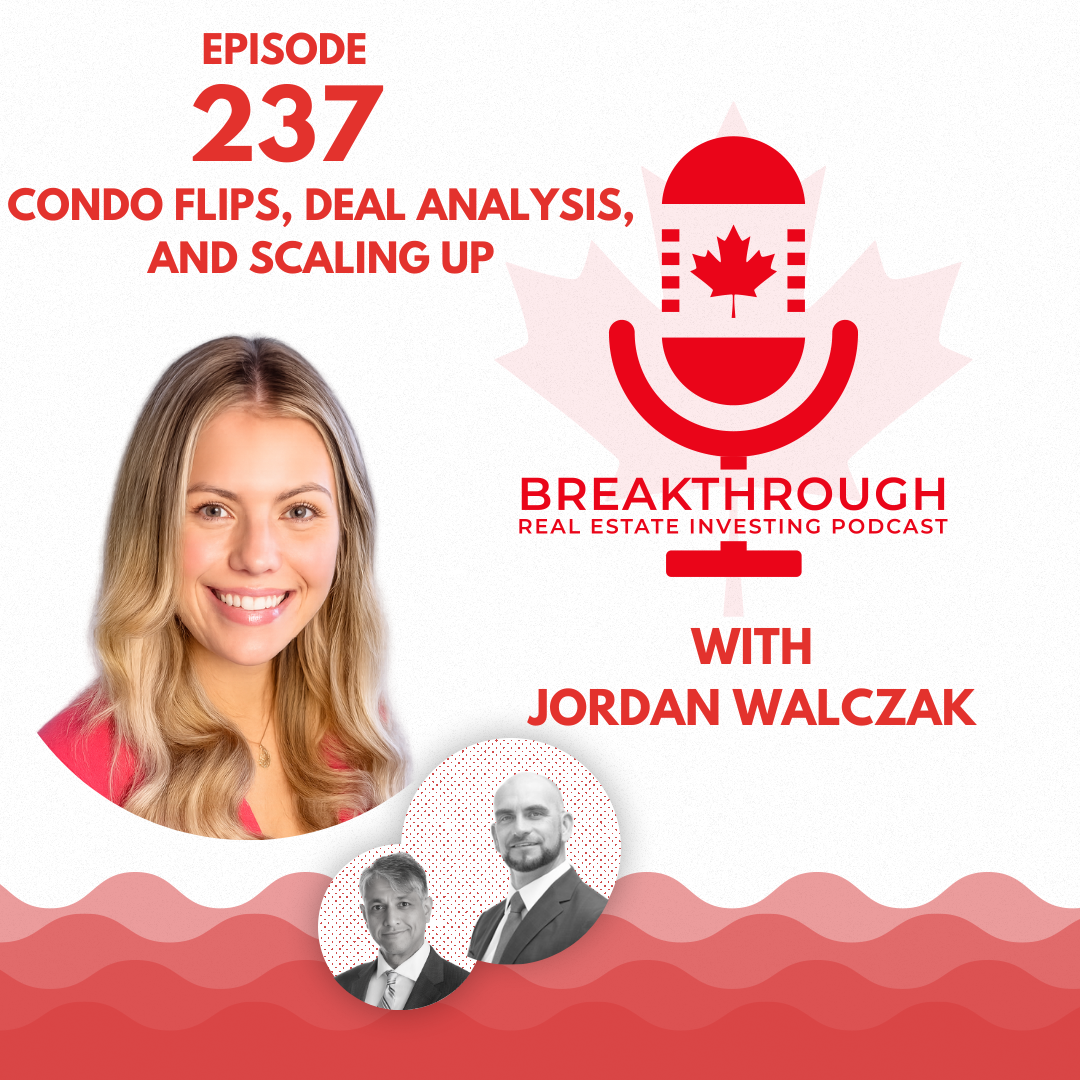
[00:04:50] Speaker C: So Jordan Wolzak is a Vancouver island born investor who bought her first home at the age of 19 years old and has been breaking barriers ever since. After moving to Calgary at 20, she found Sterling investments, built experience across flipping, burrs, wholesaling, strs leasing, property management and holds her real estate license. Still under 30, she's flipped 22 properties including a five unit condo portfolio where she raised just shy of 2 million.
Her mission is to inspire young and female investors to pursue big goals.
[00:05:26] Speaker B: Yeah, welcome. Thanks for joining us.
[00:05:28] Speaker D: Yeah, thank you so much for having me. I'm very excited to be here. That was a great.
[00:05:32] Speaker B: Yeah, I can see from what Quinton said here, flipping burrs, wholesaling, short term rentals, leasing, property management that you really focused in and, and yeah, I've explored it all.
[00:05:43] Speaker D: I knew it's going to be real estate, but it took a while to figure out where that was exactly going to land.
[00:05:49] Speaker B: Well, can you tell us how you got started?
[00:05:51] Speaker D: Yes, I would love to. So rewind. Way back, I've always been infatuated with independence and freedom.
And back when I was 14 years old, I had heard from my nana's friend's daughter that she had bought in a condo and rented out one of the rooms and essentially lived for free. So that concept always stuck with me.
And while everybody else in high school was figuring out what they wanted to do post secondary, my priority was to buy a property. So I did my high school online. I worked three jobs, I worked my butt off and I got it done. I bought my first house at 19 and I always knew that it would be great, but I had no idea how pivotal it would be in my life.
That property, by the end I was cash flowing about $1400 a month. I'd bought it for 330 and I sold it for 505 and I was paying down the mortgage. So all around just an amazing investment. And it really opened my eyes to the fact that it wasn't just going to be a one time move for me. I saw a career in it and it took a long time to figure out what that looked like. So back to all the different avenues I went down. I worked in property management, I worked in leasing.
I was trying to figure it out. And what really landed for me was when during COVID I attended Tara K. El Moussa's free weekend seminar about real estate investing. And I was just absolutely mind blown.
I at that time had no idea how people utilize sales for training programs, but I fell right into the trap. I wire transferred $15,000 that week and joined the program. And it was the best thing I ever did. I worked with coaches and learned from lots of training videos and that's what ultimately got me introduced to the flipping world. And it's been all hail Mary ever since.
[00:07:56] Speaker B: So yeah, that's the thing with those kind of courses too. It's like if you're going to put $15,000 down. You make it work no matter what. So then you put. It pushes you to take the action that you know you need to take in order to get started with that stuff.
So that's cool. That's. That's kind of inspirational. Did. How was it. Like, how did you find the course and how did it. Were you looking at other things and this one just captured you more than the other ones, or what was it?
[00:08:22] Speaker D: So I was curious about real estate investing, and I was listening to podcasts like this one and reading books and doing what I could, but I just felt like I wasn't getting all of the facts. Like, I wasn't able to quite piece together exactly how to get these things done.
So I found the course really great because I was able to really build a foundation before I went out on the field. And then I did utilize my coaches, especially in the first couple projects, to lean on with questions and just really hold my hand through the process.
And again, I just think that course was so helpful in my career. And I know courses sometimes have a bit of a bad rep, but my experience was phenomenal. And you just want to make sure you're learning from qualified people, really.
[00:09:11] Speaker B: Maybe you'll take two seconds of an opportunity here. Quentin, you still got your course, don't you? Someone else runs it, though, right?
[00:09:17] Speaker C: No, we still. I still run it, too. I do. I do coaching around it, but we'll probably take on some coaching clients in the. In the spring, so probably, like in January. But mostly we focus on, you know, people who are interested in kind of scaling up their portfolio. But, yeah, I mean, it is. It definitely is something that you have to be careful of because there are a lot of people out there who offer programs, and they don't even have the same experience that they're, you know, that they're trying to teach. So it's good that you, you know, you. You were able to get that benefit out of the program that you attended.
And was it. Was it specifically around condos, or was it detached properties, or how did you get into the condo space versus everything else?
[00:10:09] Speaker D: So the course is pretty well rounded that way. It did tailor to all different types of flipping and wholesaling and other avenues as well, but primarily flipping. And no, I had no idea that condos would become my niche. I started with one because it was an easier entrance in my eyes, and I just really loved them. So I continued with them, and to this day, I still take them on.
[00:10:37] Speaker C: Cool. So was there something about it, like, was there.
Was it easier or harder than, like, other types of properties? What. What was it about it?
[00:10:48] Speaker D: Yeah, so good question.
So I'm a little bit of a perfectionist, and I just really want to feel confident going into any project that I take on. So I felt like with the condos, it was a little bit simpler than a detached property. The things that I really like about the condos is that it is a lower entry barrier, so less capital needed, less capital to raise. That was definitely attractive to me. And then another thing is that even if I'm doing a full gut on a condo, I can be in and out of that project in 30 days. So the market doesn't have as much time to fluctuate, which was always a really nice safety net for me.
And then the third thing is just that with condos, you're typically only responsible for everything with inside the walls.
So it left cosmetic. And me personally, I love design.
That's been one of my favorite things in this journey. I love the cosmetic stuff. So it was really just focused on that, and I appreciated that.
[00:11:57] Speaker B: Yeah, that definitely cuts a lot of things out there. There's like, on the other side of that, there's, like, different rules that you have to follow in order to do the condos, but you're not dealing with, like, landscaping, new fences, I don't know, siding, roof, any of that stuff.
[00:12:13] Speaker D: Yeah, none of that, which is really nice.
But definitely there are some drawbacks. So you're dealing with condo boards, and that is a whole beast on its own.
Unfortunately, they do have the jurisdiction to govern the project to some extent. So you are limited, depending on what hours and days that they'll allow.
They're screening your contractors, they're screening the materials you're using.
There's extra protocols to follow.
Sometimes you're having to deal with elevators, which can be very inconvenient, and some require you to pay for those. And at $200 a booking, when you're doing demo, having appliances delivered, those add up quickly. So those are definitely things to consider when going into them. But I think that the benefits are worth the drawbacks.
[00:13:06] Speaker B: So tell us just a little bit, maybe deep dive into the first one that you did. How did you find it, what made it appealing to you, and how did it turn out and all that.
[00:13:18] Speaker D: Yeah, so I was so excited to do my first project. Oh, my gosh. But I remember I found this condo very randomly. It was on Kijiji. The courts in Calgary had listed the judicial sale.
And so funny. I actually went to the courthouse and brought a check. And I guess it was supposed to be a bank draft, but I brought a physical check, so I didn't want them to not approve it. So in the hearing I like stood up and told them that I was a cash buyer and they ultimately accepted my offer and I got the property that way. And actually I got a. A few after that from judicial sales as well. It's not really common anymore that I'm seeing those, but it was a great means of finding flippable properties in the beginning for sure.
[00:14:11] Speaker B: So explain how you find that. Like, where do you, where does. How does it come to your attention?
[00:14:17] Speaker D: Wow, that was a few years ago, but I was, I think, just browsing on Google looking for any ways that I could find properties.
And yeah, I mean, I definitely didn't go directly to Kijiji to start looking, but somehow I landed there and I'm so glad I did. I probably bought at least five properties directly from the courts. And it was interesting because there was never any competing offers. So I felt like it was a little secret spot that I had found that no one else had discovered yet. And I. The first one, I gave them exactly what they were asking for. But after realizing that nobody else was competing, the next one, I went in ten grand under and they accepted it. And so I just started to really lean into that for the following properties.
[00:15:07] Speaker B: Oh, that's interesting.
And then what did this one need?
Like, why did it, like, what kind of fix did the first one need?
[00:15:17] Speaker D: So what was the question?
[00:15:19] Speaker B: What. What kind of renovations did the first one need? Oh, because you bought it sight unseen, right?
[00:15:27] Speaker D: Yes. And knock on wood, I haven't had actually any bad experiences purchasing judicial sales. And I will say too, with condos, I like to look at the condo documents beforehand, but with inspections, I. If I can, I will. I always think it's helpful if you can do that, but sight unseen, you know, I don't. I'm going to be replacing everything in the property anyways, so for me that's not as mandatory. But yeah, luckily I didn't have any bad experiences buying anything sight unseen. Obviously they're dated and run down, but I never dealt with any hoarders or any major issues that caused me troubles, luckily.
[00:16:10] Speaker B: So you were expecting a full renovation on this first property?
[00:16:14] Speaker D: Yes. So you're doing everything cosmetic, so floor, paint, all new cabinets, countertops, tile, bathtub, vanities, all of the things cosmetic.
[00:16:28] Speaker B: And then like. So this program taught you how to budget and get everything together so you knew what you were facing before you even started. You basically said, I'm guessing, like tell me if I'm right. Like you basically said, all right, I didn't get an inspection on this place, so worst case scenario, I have to replace absolutely everything. And in that case, here's my budget and it still works out.
[00:16:52] Speaker C: Yeah. The interesting part is that this the like the most expensive things you can think of.
If it's a condo in an apartment building and I'm assuming these are the condo townhouses or condo like apartment buildings.
[00:17:07] Speaker D: It was an apartment building and typically in older buildings like 1970ish.
[00:17:13] Speaker C: So other than the condo fee, you're really not worried about structural. You're not worried about like the big expensive items like the H vac or you know, those sort of things.
[00:17:24] Speaker B: Foundation.
[00:17:25] Speaker C: Damn.
[00:17:28] Speaker D: I get to skip all those things, which is really great. But again, I always look at the condo docs so I won't hire a professional to actually go through them all. But I'll take the time to look at how healthy is the reserve fund, what type of larger maintenance items are coming up and determine if I think it will be okay for the resale. Because I did almost get burnt recently on a property. So the reserve fund was very much depleted and there was big items coming up for maintenance. And I talked to the condo board and management and they said that they would exhaust all other options and they had no intentions of a special assessment. Well, the condo market in Calgary slowed down so the property sat a little bit longer.
And throughout that time things changed and they ultimately were contemplating a special assessment. Now luckily I did sell that property. The first deal fell through. The second one was a success.
But I really did think that we would get hit with a large special assessment.
[00:18:34] Speaker C: So.
[00:18:34] Speaker D: So yeah, I mean if, if there is red flags in the condo docs, you just want to make sure that you're negotiating that into your price.
People will still buy them, but you just want to make sure that your numbers are protected.
[00:18:45] Speaker C: That's cool. So that, that's a mistake that people often make then I guess when they're looking at condos because people don't. I don't think everybody understands the idea of special assessments, but more and more that seems to be the case. And the other like we've got some properties in Florida and one of the things that's happened down there is the like just the changing of the condo rules for condo boards and how things work has caused the costs and the reserves to kind of come forward and all of a sudden you have these huge expenses that are, that are affecting the values of the condos. I mean, you must, there must be other mistakes that you see happening when it comes to flipping condos.
[00:19:36] Speaker D: Yeah, definitely. So I would say the two major ones that stand out is one following the condo boards protocol. So I kind of think is condo boards as having their own personalities. They each have their own rules, their own protocols, the way that they respond to things.
So I'm always looking in advance at what their renovation request form looks like and making sure that all my contractors are very much aware of what that looks like. So I go as far as posting that in the property so that no contractor can even come back at me and say, well, I didn't know we had to stop work at five o'.
[00:20:18] Speaker B: Clock.
[00:20:18] Speaker D: Well, it's posted on the wall, so there's no arguing that.
But yeah, the condo boards, they're no strangers to levying sanctions if you're not abiding by their rules. So it is really important that you follow what their expectations are or else it will cost you. And ultimately they do have the right to put a stop work order on your project if you're not complying. So it's really important that you do. And I think newer investors sometimes overlook just how much power they have. And the other thing is, is the numbers. So with a condo, as much as a $10,000 paycheck is not a horrible paycheck. If you go into a condo flip with that expectation, it is super easy to have that profit eaten up. All it takes is your project to go slightly over budget, the market slows down, or you go into winter and you have to drop the price a little bit and boom, all your profits gone. So as much as you are comfortable going ahead with a project for a $10,000 paycheck doesn't always mean you should. And I think that's something some investors with condos do overlook.
[00:21:31] Speaker C: It's interesting, like in, in Toronto, like condos has just gone like crazy down, right? It's like crazy. And it's such a challenging market right now, but people are still making money. Like people still make money. And I think that people forget that, that, that there's opportunity. It's just understanding how to uncover that. But there, there must be like, things that you do to analyze a condo to make sure that it makes sense. So what are the, what are some of the things that you look for when you're analyzing it as a potential flip?
[00:22:12] Speaker D: Yeah, so there's two calculators that I use and I consistently, to this day, still work on and add to, but one of them being a construction cost estimator.
So I've got all my numbers in this document dialed in, and they're a reflection exactly of what my contractors charge me.
So it's got, for example, $2 a square foot for the vinyl plank flooring. I go and input how many square feet is the property, and it punches out that number of how much the flooring is going to cost. And I've got a line item like that for every single component. So I can quickly do math and figure out what the construction cost is going to look like. And then I take that number and I put into my deal analyzer. And very similar to the construction cost estimator, the deal analyzer, I also consistently work through and update the numbers on. But it reflects what my lawyer charges me for legal fees and what the taxes cost, the condo fees. It factors in everything. And if you have those, you'll be successful in getting a really close estimate of what your numbers are going to look like. It's worked out for me. But consistently updating that is really important.
[00:23:29] Speaker C: Do you have like a spread that you're looking for between, like the construction sale and costs to what the potential sale price is? So, like, are you looking to make like 20% or 30? Is there like some numbers that, that make the most sense?
[00:23:47] Speaker D: Yeah, like, I want to see over a 15% ROI on the entire project. So I ideally like to raise capital for the whole project so that I'm not in it for anything. So it's based off of how much capital is needed entirely to calculate those numbers. I also don't want to take on anything with less than a $25,000 profit. And that gives me wiggle room in case the unforeseen happens.
[00:24:16] Speaker C: Right. So you're looking to make a certain percentage, but then you set a floor so that it's worth your time.
So if you were like, if, if you were to think about a typical project, how many hours do you think you would spend working on a particular project to have that floor of 20?
Is it like, like, would a flip project take 100 hours? Would it take like 10 hours? How long does a typical flip take?
[00:24:46] Speaker B: 10 hours?
[00:24:48] Speaker D: Yeah. So for me, for just me solely. Yeah, yeah. So probably about 15 hours or something. Like, not crazy amount of time if you have a good contractor dialed in and you have your systems lined up. So for me, it's, you know, running the numbers, hiring the contractor. I spent a lot of time making a very Detailed scope of work, getting more of the logistics set up. And then I am a licensed Realtor, so sometimes I'll sell my properties, sometimes I'll outsource it to other agents, but it really shouldn't take that much time if you've got a good setup in place.
[00:25:28] Speaker B: Yeah, I think that's a good point that you made there though, Quinton. Right. Like, the amount of work that it took to set it up is a lot more than what it takes now.
Right.
[00:25:38] Speaker C: Once you have a good system going, you've got a business. And, and if you, then what you. With a business, what you need is inputs and outputs and then scale, if you can, if you can scale it, then in 25k becomes, you know, 250k really quickly. But if it's not scalable, and if there, if there's one component of that that doesn't work, like you can't find the number of properties or you, you don't have financing or you can't do the capital raising piece, if any of one of those things don't allow you to scale, then what you have is, I mean, it's good, but it's not something that can, can you can take to, to be able to scale it out to do, you know, a significant, like a significant higher amount and it just becomes like something that you can add in and maybe do once in a while. But what, what I'm looking for when I see something like this is how can I scale this so that I can take it and make it into a business so that I don't have to. I can be in Mexico for a month and, and do the same things that I normally do. Right? Because then I have a business, I don't have a. Another job. Right? And that's what I'm, I'm looking for. And whenever I'm looking at different projects and things.
But I, I mean, I'm, I'm really so impressed with, you know, what you've been able to do starting so young, getting into like, all, all these different projects and, and understanding, you know, the business components of it. Because it's, I mean, there's a lot of analysis, there's a lot of, you know, managing trades, which is a whole, you know, different ball game when it comes to, you know, especially if you're not understanding something or you understand something and they, and they think you don't understand it, which is often, you know, can be an interesting challenge to deal with. So you must have put up with a whole bunch of crapola over the Last, you know, whenever you're doing these projects, right, you must. Do you have some valuable lessons that you can, can share with us?
[00:27:50] Speaker D: Yeah, well, I mean being a young female in this industry does have its challenges. So I didn't know anything about construction going into this. Like I didn't even know what a hammer was basically.
And so I wanted to learn at least a general amount of information on, I mean anything that I'm doing. But with construction, like I did work on site for a bit beside contractors to learn I gc'd some projects and that was definitely something I'm grateful for because it allows me to have those conversations with contractors and be taken seriously. I think sometimes people will underestimate me in this industry, but once they know that I do have an understanding and I know what I'm talking about and I know what I'm looking for, it really changes the game.
Sorry, the question was valuable lessons, right?
[00:28:49] Speaker C: Yeah, absolutely. From what, from your experience to date?
[00:28:52] Speaker D: Yeah, yeah.
And like I was saying, the condo docs are really important to always be looking at.
[00:29:04] Speaker C: How about I give you an example here. I like, I actually funny enough, I just inherited a condition condo, apartment building condo and I, and like I've, I've always kind of, I've never owned a condo. Like I, I've had condo townhouses but I've never owned it. And now I've got to figure out what to do with this thing and like you know, get. It's in a working class, like a Scarborough neighborhood, which is like a working class neighborhood in Toronto.
It's a one bedroom condo, not very big, looks really ugly and dated and you know, and I need to make this kind of rent ready.
What, what would you suggest to somebody like me who came into this? Like what, how do I make this thing shine so we can get the most value for the family?
[00:29:58] Speaker D: Yeah, well I would definitely look at your comps and see what makes sense. You never want to over renovate, but if it's gonna stay as a rental.
[00:30:07] Speaker C: You said no, no, we're gonna sell it. I, I have, I have no interest in owning like a condo in, in Toronto. Sorry for all the people that do. But, but I don't, I don't want one. So we're, we. I inherited this and now I've got to sell it and, and then we'll like, the funds will go to the family like our, I don't want to hold on to it. But in a market that's not moving, which is Toronto right now, give me some ideas what could help me?
[00:30:42] Speaker D: I think design is really important, and again, that's my favorite part of this whole journey. And so I would recommend being a property that stands out. I think there's a lot of investors out there that will just throw on white cabinets and white counters, and it's just so generic. But if you want to stand out, it's the small things, I think, that add up. So I'm utilizing, like, textured panels underneath islands or accent walls. I love towel racks. That's always a nice elevation to a bathroom.
Kind of gives it a spa like vibe.
I. Yeah, try and do accent walls and just. Just anything that is going to make it stand out amongst the rest. I think a really good design is really important. And ultimately, if someone can fall in love with the property, they'll pay more than maybe even what it's worth if they feel that strongly. So you want to capture their attention that way.
[00:31:40] Speaker C: Like, for me, I just wanted to move. Right. Like, I. I'd love to. You know, let's. Let's just get it out. Right. But in a market where there's so many other similar properties, you're right. It's like, how do you stand out and what are the things that. That. That will help to appeal to other people, you know, to. To be able to. To pick up this particular unit versus any other unit in the. Now, I. There aren't too many. I think there's probably another one or two units available in the building.
But. And I hate to have I just kind of shanghaied this conversation because I have a question.
[00:32:21] Speaker B: Question? Do you ever sell condos, furnished or. No, that's not.
[00:32:25] Speaker C: Oh, interesting.
[00:32:26] Speaker D: I have not. No. But I don't think that would be a bad idea, especially if it was Airbnb.
[00:32:33] Speaker B: Yeah. I wonder if that might be something that might help Quentin.
[00:32:37] Speaker C: Yeah, I don't. Because it's Toronto. They have a lot of Airbnb laws. So I. I don't know if I could. I could do that, but maybe if I furnished it for the type of clientele that are in this neighborhood, maybe that would just help to, you know, help to move it because it comes furnished.
[00:32:57] Speaker B: I don't know, because that, like. Because I was thinking you said, like, the design is a very important thing, and I agree with you, but when it's unfurnished, there's like, you know, sort of limited things you can do. On every property that we sell here, more or less is furnished completely. Basically Airbnb ready. So my mind automatically went to, you know, what are the furniture Accents.
And then I, and then I kind of remembered, oh, yeah, you guys aren't doing that. So, you know, it's just a different way of looking at it, possibly.
[00:33:36] Speaker D: Yeah. I mean, I definitely think it could be worth a try. I did accumulate furniture over the years I've been doing this, so I was staging a couple of properties of my own, and I always left it kind of up for interpretation, like if they wanted to negotiate the furniture in. If they didn't, I was flexible with that. And I did have more than one group negotiate the furniture in. So I think that there is a possibility for that. There.
[00:34:04] Speaker B: There you go. We helped Quinten.
[00:34:07] Speaker C: Appreciate that. Thank you.
Thank you. Yeah, you never know what's going to happen, right? So, but I thought, you know, this is a perfect conversation for, to help me out a little bit. So I'm just kind of curious.
We've talked a lot about, you know, what you've done in the past. Well, what's next for you? What are you gonna, like you accomplished so much so far.
What's next for you?
[00:34:36] Speaker D: Yeah, so I just have such a passion for real estate, and I am continuously wanting to learn more and grow, and so I do have a good foundation with these condo flips, so I would like to continue with them because it doesn't require a lot of my time anymore at this point. But furthermore, I'm in the midst of getting my commercial real estate license in the moment, and I'm also undergoing Pierre Paul Terjean's multifamily investing course, which I know you guys have had him on the podcast a couple of times. So I would really like to break into the multifamily space. I think I have obviously a lot of knowledge with the condos, and I think I'm ready to branch into more of the exterior and just bigger projects overall.
[00:35:23] Speaker C: That's awesome. So are you looking to get into, like, as an investor or as a sales rep or both or something else?
[00:35:33] Speaker D: Probably both.
I think investing is most ideal to me, but I also think that working with clients is an extra stream of revenue. It builds confidence in the space. So, I mean, just like my residential license, I do take on clients there, and it's been great. So I'm not opposed to doing the same with commercial, but it is mainly with investing in mind.
[00:35:59] Speaker C: Okay, that's great. I, I, I, I couldn't do what you and, and Rob do. I, I can't work with people who don't want to do what I tell them to do. If you, if I tell you to buy something and you don't buy it, I'm gonna fire you. Like, sorry, I don't care.
Why'd you hire me then?
Yeah, sorry, I know it doesn't work.
[00:36:24] Speaker B: Starts his meetings by saying, you know, if you're not gonna buy anything, I don't want you here. If you're not gonna take some action, don't come back next month. Yeah, you know, it's like, guess I better buy something. I want to come back.
I do want to ask you one more question, though, before. Before we go, because I. We don't always just want to talk about everything that's went well, you know, and you've obviously, you know, had a lot of success in this. But what are some of the things? Like, what are. What are some of the projects that maybe didn't go exactly the way you planned them? And how did you overcome obstacles in that way?
[00:37:02] Speaker D: Yeah, so there's a couple that come to mind.
One kind of reflects what I said earlier. You go into a project with the intentions of a small profit and it gets eaten up really quickly. So I had a townhouse like that. It was one of the first few properties I did, and to me, I just thought saw it as a quick in and out project, make a quick buck and long. Behold, things didn't go exactly as planned. Construction went over slightly. We were going into winter, and I ended up breaking even on that project. So after that, I told myself, I'm not taking on projects with a $15,000 projection at the end. It's just not worth the risk.
And another one that comes to mind is recently I underwent my largest project yet. So I flipped five condos in a portfolio. And now, unfortunately, the condo market in Calgary really took a turn throughout that process.
So that was challenging because you're competing against yourself. I had never had so many in one building, but you just want to have plan B's if you can. So we ended up staging some of the properties and renting them out so that we didn't have so many on market.
And yeah, just. I say don't be afraid to explore other options if selling doesn't always go as planned.
[00:38:26] Speaker B: So now does the plan change? Like, is that a pivot to now we got to hold these long term because there's tenants in there. Right.
[00:38:35] Speaker D: So we just had shorter term, not Airbnb, like nightly stays, but we did 30 day stays. So we did end up listing them right after they moved out, and that way we could stagger them on market. So it didn't appear to Pose any red flags for the building. Sometimes people will see numerous properties in a building listed and think wrong with the building, which you never want to have them think that. Plant that doubt.
[00:39:05] Speaker B: Okay, well, that's good advice.
Well, thank you. I, I'm really happy. What, what's that look for?
[00:39:13] Speaker C: So, like, I'm just saying that, like, this has been a great session because.
[00:39:18] Speaker B: I thought you were like.
[00:39:20] Speaker C: No, no, I like this. This is good. I actually, like, learned some stuff that I can go and apply, which, you.
[00:39:26] Speaker B: Know, this doesn't happen all that often.
[00:39:28] Speaker C: No, it happens. I'm just saying, like, I'm, I'm sure it happens for more people than, than me when, when we're listening to these. But like, this was great. I really enjoyed it and I think you're doing really well, Jordan. I really want to encourage you to keep going and continue to, to do what you're doing. Like, you're just doing so awesome. And it's good that you're striving to get into like the, the larger multifamily and, and, you know, grow, because I really think that, like, you're making income in your flips. I think you're going to get some really big net worth jumps in those apartment buildings. That's where you'll find that you're, you know, your net worth will like, grow at a much faster pace than you ever thought possible. And it comes from scaling into things that are bigger. Right. And I think that when you add a zero to whatever project you did before, that's how you're going to get into, you know, the, those bigger jumps. So I want to encourage you to keep going down that path and, you know, stick with educators that have already done it and, you know, keep going.
[00:40:35] Speaker D: Yeah. Thank you so much. I'm so excited about it and it's been wonderful chatting with the two of you. I've listened to this podcast, like I said, since probably five, six years ago, and I continue to listen to it this day. So it's really special to be able to chat with you too, like this.
[00:40:53] Speaker B: Very cool. Thank you. And I think that this is going to resonate with a lot of people who are trying to figure out what to do to start.
Right. Like, even if.
So, even if we can get their wheels turning, maybe they're looking for something to hang on to. But all. But, you know, they've, they've found that there's a lot of condos, but they just need renovations.
Right. So this is going to teach people an easier barrier of entry, I think.
[00:41:19] Speaker D: Yeah, I think it's so great for an easier entry point and it really will build you up to be able to get into bigger projects. I think it's a great starting point all around.
[00:41:31] Speaker B: Very cool. All right, well, thank you so much for sharing all this with us. So much. We appreciate it. What is the best way for people to get in touch with you?
[00:41:40] Speaker D: I would say through Instagram, my handles, Jord Wall. Or if you want to leave my number in the show notes, that's fine too. Text call. I'm easy. I'm here. I love to chat real estate, so feel free to reach out. Anybody.
[00:41:54] Speaker B: Okay, so we'll put all your contact info in the show notes so people can reach out to you that way. And Quinton, how can people get in.
[00:42:02] Speaker C: Touch with you if you want to do a 15 minute call? I actually had one with Joel recently. So shout out to Joel, just talk about real estate. He was. He needed some help with direction. Happy to do that. Go to quintenge.com and book a 15 minute call. See if I can help you out. And Rob, how can people get in touch with you?
[00:42:24] Speaker B: Go to Point Break Home Cr on Facebook and get in touch with us there. Or you can just email me robertthrough Cat. All right, thank you everybody. Appreciate you listening to us again and we will see you soon. Have a good one.